
Spring Storms Don't Wait: Capture Revenue When It Hits
Spring storms create 400% call volume spikes and 48-hour capture windows worth $60K-$125K per event. Here's the system that answers, dispatches, quotes, and closes before the surge passes you by.
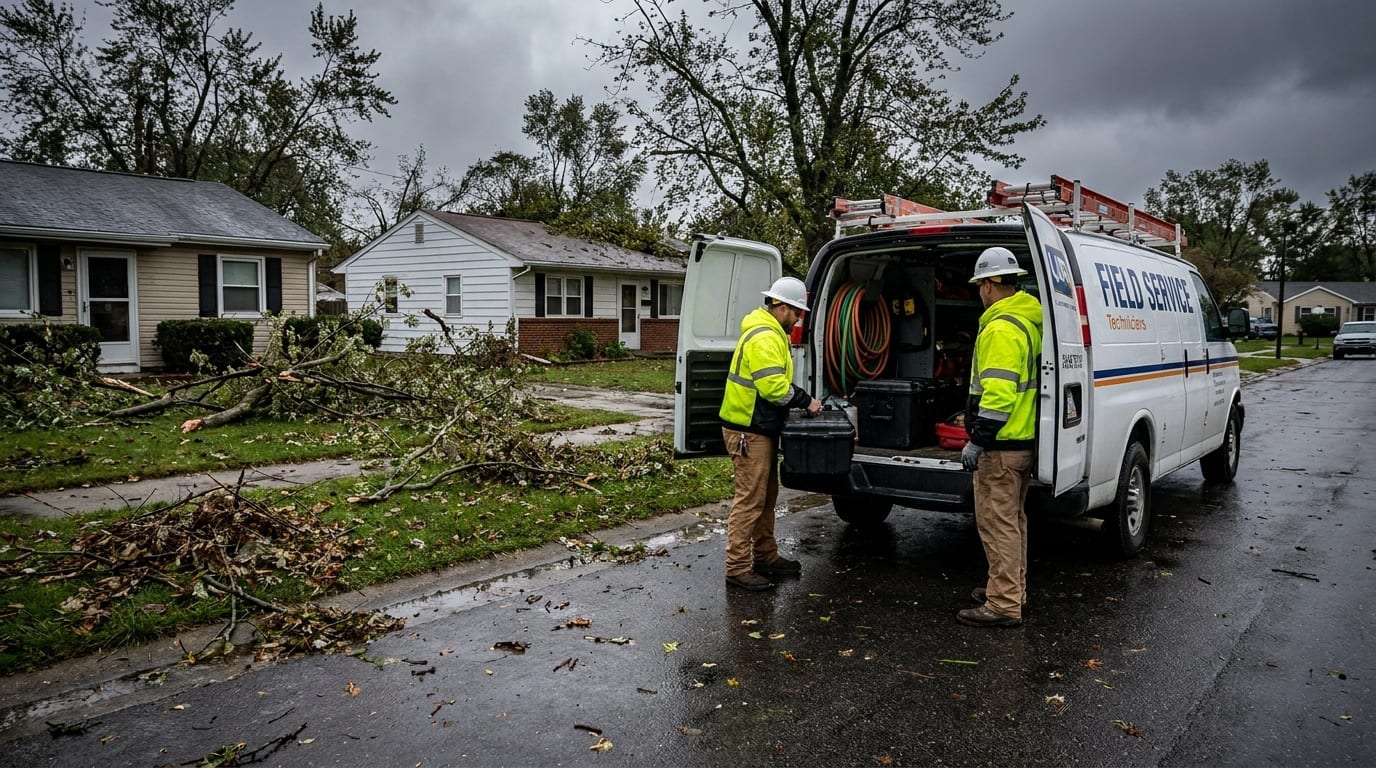
TL;DR:
Spring storm season is the single highest-value demand window most field service contractors will see all year - and the single highest-loss window for those without systems to handle the surge. NOAA's National Centers for Environmental Information documented 27 billion-dollar weather disasters in 2024, 17 of them severe storms. After a major storm event, roofing contractors face call volume increases of up to 400%, while missing 50-70% of those calls because their operations are not built for surge. This blog covers exactly what breaks during a weather emergency, what systems prevent it, and how to turn a one-time emergency customer into a multi-year recurring revenue relationship.
Why Spring Storms Are Both Your Biggest Opportunity and Your Biggest Risk
There is a specific kind of chaos that arrives with the first major spring storm. One hour you are running a normal schedule. The next, your phone is ringing faster than anyone can answer it, your dispatcher is managing three simultaneous reroutes, and somewhere in a group text thread is a customer whose flooded basement has been waiting two hours for a callback.
The demand is real and it is documented. NOAA's National Centers for Environmental Information "Assessing the U.S. Climate in 2024" confirmed that the U.S. experienced 27 weather and climate disasters in 2024, each exceeding $1 billion in losses - the second-highest annual count in 45 years of records. Seventeen of those 27 events were severe storms: tornadoes, hail, and high winds. Total costs reached $182.7 billion. The U.S. has now experienced 14 consecutive years with 10 or more billion-dollar disasters.
NOAA's Climate.gov analysis of spring disaster patterns found that spring months from March through May represent the period when multiple concurrent billion-dollar disasters are most likely, with severe storms concentrated in Central and Southeast states. April 2024 alone produced three major billion-dollar events: a central states tornado outbreak on April 1-3 that caused $1.8 billion in damage across Oklahoma to West Virginia, severe storms across the South and East from April 8-11 causing $1.5 billion, and a major tornado outbreak on April 25-28 generating more than 100 tornadoes across the Midwest and Plains.
Every one of those events generated immediate, urgent demand for HVAC contractors, roofers, plumbers, electricians, and restoration specialists. The contractors who captured that demand were the ones with systems fast enough to handle it. The Spring Lead Explosion analysis from LeadProspecting AI documented the same pattern in non-storm spring demand: HVAC, plumbing, and electrical companies see lead volume increase two to three times during the spring surge. During a weather event, that multiplier is not two to three times - it is four times or more, compressed into a 48 to 72 hour window.
What Actually Breaks During a Storm Surge
Understanding where revenue leaks during a weather emergency is not abstract. It happens in predictable places, in a predictable order, every time a significant storm hits a contractor's market.
The call volume overwhelms manual answering first. Industry analysis of post-storm roofing call patterns found that contractors routinely face call volume increases of up to 400% after a major weather event. During those surges, missed call rates climb from the normal 27% to 50-70% - because homeowners in an emergency will not wait on hold or leave a voicemail. They hang up and call the next contractor on the list.
The revenue math on those missed calls is not modest. Perceptionist's analysis of roofing storm call patterns found that a storm inspection converting to a full replacement is a $12,000 to $25,000 job. Missing five such calls in a 48-hour surge window represents $60,000 to $125,000 in revenue that went to whoever picked up. The 48-hour capture window is not a metaphor - it is the documented reality of how storm leads behave. Homeowners call in the first two days because they want assessment before more weather arrives and because they have heard that contractors book up fast after a storm. Both of those things are true.
Scheduling collapses second. A dispatcher managing 20 jobs on a normal day can hold the board together through experience and memory. A dispatcher managing 40 emergency calls on day one of a storm surge, rerouting crews around closed roads and reprioritizing jobs in real time, cannot hold a manual board together. Double-bookings and missed appointments happen not from carelessness but from the structural impossibility of coordinating real-time field operations without real-time tools.
Quote speed fails third. A homeowner dealing with storm damage wants an assessment and a number fast. They are not comparison shopping in the traditional sense - they are calling contractors until one shows up and gives them a price. A quote process that takes 24 to 48 hours because paper estimates have to go back to the office loses those jobs to contractors who can quote and close at the job site.
Collections fall apart fourth. Emergency jobs completed under surge conditions often skip the normal payment workflow. Invoices that would have been sent same-day during normal operations get delayed. Post-storm, when your crew is already onto the next job and the customer's urgency has passed, collections drag for weeks.
The Field Service Software vs. Excel breakdown covers how each of these failure modes compounds across a full spring season - not just during storm events but in the cumulative cost of manual systems under sustained demand pressure.
The Systems That Prevent Each of These Failures
None of the failures above are inevitable. Each one has a direct operational solution. Here is what those solutions look like in practice during a storm surge.
Automated missed call recovery closes the 48-hour capture window. When your phone lines are overwhelmed, an automated text response sent within 60 seconds of every unanswered call tells the homeowner their inquiry was received and a callback is coming. That single response keeps the lead from moving to the next contractor on the list. During a multi-day storm event where you are missing 50% of calls, recovering even 30-40% of those through automated text response - the documented recovery rate from automated systems - represents a significant share of the available storm revenue in your market.
Real-time scheduling with conflict detection prevents the dispatcher from failing under load. When every dispatcher sees the same live calendar and the system flags conflicts before they are confirmed rather than after, double-bookings stop being a surge risk. During a storm day where incoming job volume doubles, a system that routes the closest available technician based on GPS position and current job status removes the cognitive load that causes manual dispatch to fail.
The GPS geofencing and crew visibility blog covers how real-time crew location data makes dispatch decisions accurate rather than estimated - which matters especially when you are rerouting crews around closed roads in real time.
Digital quoting at the job site eliminates the 24-48 hour quote lag. When a technician can generate a professional estimate on a mobile device, present it to the homeowner, and collect a digital signature at the job site, the job closes before the homeowner has time to call a second contractor. During storm surge conditions, where homeowners are calling every available contractor in sequence, the contractor who can close on-site wins. The contractor who says "we'll email you a quote tomorrow" does not.
Integrated payment collection from the field prevents post-storm invoice drag. When invoices generate automatically from completed job data and go to the customer with a direct payment link, payment collection happens as part of the job close rather than as a separate administrative process days later. The payment objections and closing blog covers how to handle the specific payment dynamics that arise during emergency work - customers who want the work done now but negotiate on payment terms after the urgency has passed.
Job photo documentation protects every storm job from post-event disputes. Storm damage work is uniquely vulnerable to scope disputes three or four weeks after the event, when customers have had time to reconsider the cost and the urgency is gone. Timestamped, GPS-tagged photos uploaded from the job site at the time of the work are your evidence when that conversation happens. They also matter for insurance-related work where photo documentation is required for claims processing.
Real-Time Crew Coordination: The Logistics Problem Inside the Labor Problem
Storm response is a logistics problem as much as a labor one. During a multi-crew surge, the biggest operational challenge is not finding enough technicians - it is keeping every technician productive and correctly assigned when conditions are changing faster than a whiteboard can track.
A field service platform with mobile access gives every technician their job queue, customer history, and GPS routing before they leave the previous job. When a customer calls to report additional damage discovered after the initial visit, the dispatcher updates job notes and the technician sees the change immediately - without a phone call interrupting either of them. When a road closes and a crew needs to be rerouted, the reassignment happens in the system and every affected technician sees the updated routing without a dispatcher making three separate calls.
Geofencing and automated time tracking confirm when crews arrived and departed at each job site. During surge conditions where you are completing 40 or 50 jobs in two days, that confirmation protects you against customer disputes about whether the crew showed up when they said they did, and how long the work actually took. It also generates the job-level data you need to see which crews were most efficient during the surge - information that feeds directly into staffing decisions for the next storm season.
After the Storm: The Retention Opportunity Most Contractors Miss Entirely
Here is what most contractors never act on: a weather emergency is one of the best customer acquisition events a field service business will ever have.
A homeowner who called you during an emergency, had your crew show up fast, received professional documentation of the work, and got a clear invoice paid easily has had the best possible introduction to your business. Their trust level after that experience is higher than it would be after any number of non-emergency service calls. That trust is the foundation for every recurring revenue relationship, referral, and review that follows.
Automated review requests sent 24 hours after emergency job completion capture that goodwill while it is fresh. A homeowner who felt well-served during a stressful situation is a natural reviewer - but only if you ask at the right moment. Asking three weeks later, after the stress has faded and daily life has resumed, produces a fraction of the response rate.
Emergency customers who become maintenance agreement customers generate recurring revenue at the highest margin available in field service. The homeowner whose HVAC failed during the first heat wave of the year and had a great emergency service experience is the most natural convert to a spring tune-up and fall maintenance plan you will ever encounter. The Spring Maintenance Season blog covers exactly how contractors capture this conversion and what it is worth in annual recurring revenue.
Referral programs activated after positive storm response experiences compound further. A customer who was served well during a crisis tells their neighbors - unprompted and with genuine enthusiasm - because the bar their neighbors have set for contractor experiences is low and yours exceeded it. The LeadProspecting AI guide on generating more referrals covers how to build the systematic referral capture that turns those organic recommendations into a tracked, incentivized pipeline rather than occasional word-of-mouth.
The contractors who finish spring ahead of where they started are not just the ones who answered more calls during the storm. They are the ones who converted those emergency customers into the recurring relationships, reviews, and referrals that sustain the business between surges.
Preparing Before the Storm, Not During It
The worst time to build a surge-ready operation is when you are already in the surge. Automated missed call response, real-time scheduling, mobile quoting, and connected payment collection all need to be configured and tested before the first storm of the season - not after.
The practical preparation timeline runs roughly as follows. In February or March, before spring storm activity begins, configure your automated missed call response sequences and test them with real call scenarios. Set your scheduling system to flag conflicts in real time and brief your dispatcher on how to use live routing rather than a manual board. Brief your technicians on mobile job documentation - photos, notes, and digital signatures at the job site. Configure your automated invoice generation so it fires from job completion data rather than requiring a separate office step.
By the time the first significant storm hits your market, your operation should be running the surge-ready workflow on normal days so that scaling it to surge conditions requires no additional setup - just more volume through the same system.
The preparation investment is not primarily in the tools. It is in building the habits before the pressure arrives.
Ready to Run Surge Season Instead of Surviving It?
Spring storms are becoming more frequent and more costly. NOAA documented 27 billion-dollar weather disasters in 2024, the second-highest count in 45 years of records, with 17 of them severe storms. That demand is not going away. The contractors who build systems to capture it will grow. The ones who keep relying on paper, spreadsheets, and group texts will keep losing the 48-hour capture window to whoever picks up faster.
FieldServ AI connects scheduling, real-time dispatch, mobile job documentation, automated missed call recovery, integrated payment collection, and review requests in one platform built specifically for field service contractors. When the surge arrives, the system handles the administrative load so your crew can focus on the work.
Start your free 21-day trial and configure your storm-ready workflow before the next weather event hits your market.
Frequently Asked Questions
Can field service software actually help during a sudden storm surge, or does setup take too long?
The value of the software during a surge depends almost entirely on whether it was configured before the surge arrived. Core features like real-time scheduling, automated missed call response, and mobile job documentation are active within hours of setup. But the real preparation is operational: your dispatcher needs to be running live dispatch rather than a whiteboard before the storm, your technicians need to be documenting jobs on mobile before the surge, and your automated workflows need to be tested before call volume quadruples. Setup is fast. Habit formation takes a few weeks. Start before storm season, not during it.
How does automated missed call response actually work during a surge when lines are overwhelmed?
When an inbound call goes unanswered, the system sends an automated text to the caller within 60 seconds. The text acknowledges the inquiry and sets a callback expectation - which keeps the homeowner from immediately calling the next contractor on their list. During a storm surge where your missed call rate climbs from 27% to 50-70%, even recovering 30-40% of those leads through automated text response represents significant captured revenue that would otherwise go to competitors who happened to pick up.
What documentation do I actually need for storm damage work, and why does it matter later?
At minimum: timestamped photos of the damage as found before work begins, photos of completed work, technician notes on the scope and materials used, and a customer signature acknowledging the work performed. Storm damage disputes typically arise three to six weeks after the event, when the urgency has passed and the invoice amount feels larger than the emergency felt. A timestamped photo record from the job site is not just useful in those conversations - it usually ends them. For insurance-related work, photo documentation is often required by the claims processor before payment is released.
How do I convert emergency customers into recurring maintenance relationships without it feeling like a sales pitch?
Timing is everything. The best moment to offer a maintenance plan is at the end of a successful emergency visit, while the technician is still on site and the customer is relieved the problem is solved. Framing it around prevention rather than sales - "given what happened today, a spring and fall check would catch this before it becomes an emergency next year" - is accurate, useful, and lands as professional advice rather than upselling. The customers who say yes in that moment are the ones who just experienced firsthand what happens without regular maintenance.
Should I adjust my pricing during a storm surge, or keep rates consistent?
Standard service rates apply during normal surge conditions. Emergency and after-hours premiums are appropriate for calls outside business hours or requiring immediate same-day response, and those premiums should be communicated clearly in advance rather than discovered at invoice. Price gouging during declared weather emergencies carries legal risk in many states and reputational risk everywhere. The revenue opportunity during a storm surge comes from volume and speed of capture, not from elevated rates on distressed homeowners. Contractors who charge fairly and perform well during emergencies build the referral relationships that outlast the storm by years.
Tags
Written by
FieldServ AI Team
Field service management insights from the FieldServAI team.
Related Articles

Field Service Management Software: 6 Fixes for June Revenue Leaks
June is your busiest and leakiest month. Here are 6 field service management software features that stop revenue leaks and keep multi-crew operations profitable.

The August Margin Leak: Why Peak Season Kills Profit
Contractors lose margin in busy months, not slow ones. Here are four peak-season leaks that never reach your revenue report, the math behind them, and why weekly margin review beats a monthly close.

Field Service Management Software: Set It Up in 48 Hours, No IT
Think field service management software needs IT skills? Myth busted. Here's the exact 48-hour, no-code setup plan solo contractors use to go live.
See FieldServ AI in Action
Get a personalized demo and see how AI-powered field service management can transform your business.
Book Your Demo