
The August Margin Leak: Why Peak Season Kills Profit
Contractors lose margin in busy months, not slow ones. Here are four peak-season leaks that never reach your revenue report, the math behind them, and why weekly margin review beats a monthly close.

TL;DR
- Peak season is when field service margin dies, not slow season. Volume hides the leak until the books close.
- Construction and trades employment peaks in August, roughly 7 percent above the annual average, according to Federal Reserve Bank of Chicago research. Your labor cost spikes at exactly the moment your coordination gets worst.
- The four leaks that eat peak-season margin are drive time, callbacks, overtime premium, and lost booking slots. None of them show up on a revenue report.
- A worked example below shows how those four leaks can quietly consume roughly a fifth of a four-tech shop's August gross margin. The numbers are an illustration built on stated assumptions, not a sourced statistic.
- The fix is margin visibility measured weekly, not monthly. By the time August closes, the money is already gone.
Your Revenue Report Is Lying to You
It is the second week of July. Your phone has not stopped, your crews are booked out, and the deposits look better than they have all year. Every instinct tells you this is the good part.
Then August closes, you sit down with the books, and the profit is not there. Not the way the volume said it should be.
This is the summer trap, and it catches good contractors every year. You do not lose money in the slow months. You lose it in the busy ones, when volume is high enough to disguise the leak and chaotic enough to widen it.
The revenue report says August was your best month. The margin report, if you were running one, would tell a different story.
Why Peak Season Attacks Margin Specifically
Start with the labor side, because that is where the math turns against you first.
Research from the Federal Reserve Bank of Chicago found that construction employment hits its trough in February, roughly 10 percent below the annual average, and peaks around August at roughly 7 percent above it. That is a swing of about 17 percentage points inside a single calendar year. The Bureau of Labor Statistics describes the same pattern in its own data, noting that construction adds jobs through spring and summer and sheds them once the weather turns.
Translated into your P&L, this means your payroll is at its heaviest exactly when your scheduling is at its messiest. Every hour of inefficiency in August costs more than the same hour in February, because you are paying more people, more of them are on overtime, and every one of them is burning fuel between jobs.
Then add heat. OSHA notes that heat stress degrades fine motor performance even in workers who are acclimatized to it. In the rulemaking record for its proposed heat standard, the agency cites a global meta-analysis finding that about 30 percent of workers who experienced hazardous heat during a single shift reported productivity losses. Your techs are not slacking in August. They are slower because the physics of the human body says they will be.
So peak season hands you three things at once: your highest labor cost, your lowest labor productivity, and your highest coordination load. Volume papers over all of it right up until it does not.
The Four Leaks That Do Not Show Up on a Revenue Report
Revenue is easy to see. Margin erosion is not, because it happens in units too small to notice individually.
Drive time. Fifteen extra minutes between jobs feels like nothing. Across a fully booked month it is a part-time salary. Poor routing during peak season is the single largest and least visible margin leak most shops carry, and it compounds because the more jobs you cram in, the more inefficient the sequencing becomes.
Callbacks. Rushed summer work produces rework. A callback is a job you perform twice and bill once, which means it does not reduce your margin, it inverts it. Every callback carries drive time, labor, and often parts, against zero revenue. We ran the numbers on this in June Callbacks: Field Service Management Software Stops $8K+ Loss.
Overtime premium. Base wages are a cost you planned for. The premium half of time-and-a-half is not. Ten hours of overtime per tech per week is normal in August, and the premium alone is pure margin, coming straight off the bottom.
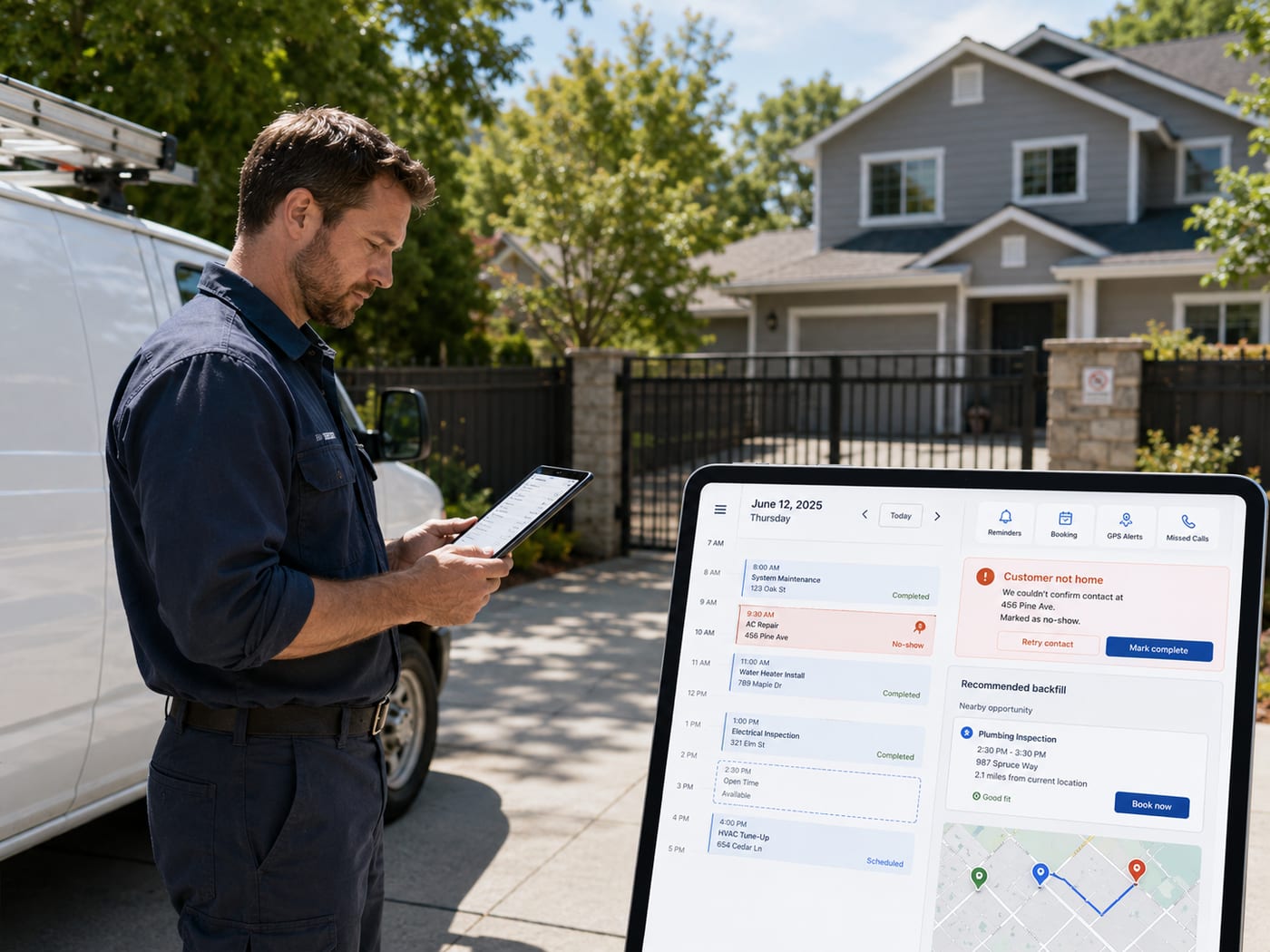
Lost slots. In a month where every slot is spoken for, a no-show or a double-booking does not get made up later. There is no later. The slot is gone and so is its entire contribution margin. We covered the mechanics in June No-Shows Cost $7K+: Field Service Management Software Fix.
Notice what these four have in common. Not one is a demand problem. Not one is fixed by working harder. They are coordination failures that convert into cost, silently, at a scale that only becomes visible after the month is closed.
What the Leak Actually Costs: A Worked Example
The following is an illustration built on the assumptions listed, not a sourced statistic. Run your own numbers against your own job history and you will get a different total. That is the point.
Assume a four-technician shop in August:
- 22 working days, 5 jobs per tech per day, for 440 completed jobs
- $400 average ticket, producing $176,000 in August billings
- 35 percent gross margin, or $61,600 of gross margin for the month
- $60 per hour fully loaded labor cost, $35 per hour base wage
Now the four leaks:
Drive time. Fifteen extra minutes per job from unoptimized routing. That is 110 hours across 440 jobs. At $60 loaded, the cost is $6,600.
Callbacks. A 4 percent callback rate is 18 return trips. At two hours each including drive, that is $2,112 in labor, plus roughly $600 in parts across those trips. Call it $2,700.
Overtime premium. 100 overtime hours across the crew. On a $35 base wage, the premium half of time-and-a-half is $17.50 per hour. The cost is $1,750.
Lost slots. A 3 percent loss to no-shows and double-bookings is 13 jobs. At $400 each and 35 percent margin, the cost is $1,820.
Total: $12,870, or roughly 21 percent of the month's gross margin.
You did not lose a single customer. You did not lose a bid. Your revenue report shows a record August. And a fifth of the profit is gone.
Multiply that across June, July, and August, and you see why so many contractors finish their strongest quarter wondering where the money went.
Margin Visibility Is the Actual Fix
Here is the uncomfortable part. Most contractors already know about drive time and callbacks. Knowing has not helped, because knowing about a leak in the abstract is not the same as seeing it while it happens.
The contractors who protect peak-season margin do one thing structurally differently. They look at margin weekly, not monthly.
That requires three things a whiteboard cannot give you:
Job-level costing, not month-level. You need to know which job types, which crews, and which service categories are actually profitable, at the job level, while the month is still running. Averages hide everything. A 35 percent blended margin can easily contain a service line running at 12 percent and another at 55 percent, and the blended number will never tell you which is which.
Verified labor hours, not reported ones. Location-verified time tracking and geofencing turn labor from an estimate into a measurement. This matters more in August than any other month, because that is when the gap between hours paid and hours worked is widest. We looked at this specifically in GPS Tracking and Field Service Management Software: Stop $4K+ Phantom Hours.
Revenue that closes. Peak season is when invoicing slips, because the office is as overloaded as the field. An invoice sent nine days after job completion is not revenue. It is a hope. Automated invoicing at job close, with integrated payment collection, is the difference between a profitable August and a profitable August you actually get paid for.
Field service management software is not magic here. What it does is make the invisible visible in time to act on it. A live margin view during the second week of August lets you reprice a bleeding service line, reassign a crew, or shut off a lead source that is feeding you unprofitable work. The same information delivered on September 5 is a post-mortem.
The Rest of Your Summer Is Not Lost
If you are reading this in July, you have not missed your window. August is still ahead of you, and it is typically the heaviest month of the year. Four moves, in order of impact:
Pull your job costing for June and July right now. Not revenue. Margin, by job type and by crew. Find the two service lines that are underperforming and either reprice them or stop selling them until October.
Audit your drive time this week. Pull the actual travel time between completed jobs. If the average exceeds 20 minutes in a dense territory, your routing is the leak, and it is the cheapest one to fix.
Cap overtime deliberately, not accidentally. Decide the number of overtime hours August is allowed to have. Unmanaged overtime is not a labor decision, it is a margin decision that got made for you.
Convert the volume into next winter. August customers are the cheapest recurring-revenue leads you will ever have, because they are standing in front of you with a fixed problem and a warm feeling about your company. A maintenance plan offered at the close of an August repair is what makes February survivable. We broke that model down in Recurring Revenue for Contractors.
The demand is real, and it is durable. Harvard's Joint Center for Housing Studies projects that annual homeowner spending on improvements and maintenance will reach roughly $518 billion by the end of 2026, growing at about 2.1 percent mid-year. On the cooling side, EIA's Residential Energy Consumption Survey found that air conditioning accounts for about 19 percent of electricity consumption in American homes, and that roughly 88 percent of U.S. households use it. The AC calls will keep coming. The only open question is what margin you keep on them.
An Honest Limitation
Software will not fix a broken pricing model. If your average ticket is priced below your true loaded cost, better routing just helps you lose money more efficiently. It will not fix a hiring shortage either, and it will not make a technician who is not there show up.
What it eliminates is the coordination chaos that turns a well-priced, well-staffed operation into an unprofitable one. That is a real problem worth solving, and it is a different problem from the two above. Solve the pricing first. Then solve the chaos.
Frequently Asked Questions
Q: Why would my busiest month be my least profitable one?
Because margin erosion scales with volume. Drive time, callbacks, overtime premium, and lost booking slots all grow as job count grows, while your revenue report only shows the top line. High volume simultaneously increases the leak and hides it.
Q: I check my P&L every month. Is that not enough?
A monthly close tells you what happened. By September 5 you cannot reprice an August job, recover an August callback, or reclaim an August slot. Weekly margin review, at the job level, is what lets you correct a problem while it is still correctable.
Q: What is the fastest peak-season margin fix?
Routing, almost always. It is the largest of the four leaks in most shops, it requires no pricing change and no difficult conversation with a customer, and the improvement shows up in the same week you make it.
Q: Is it too late to set this up mid-season?
No, though you will be learning under pressure. Setting up scheduling, dispatch, and job costing during a shoulder month is easier. Setting it up in July still leaves you the heaviest month of the year to benefit from it.
Q: I am a solo operator. Does this math apply to me?
The percentages do, and arguably more so. A solo operator cannot answer the phone from a crawlspace, which means lost slots and drive time hit you harder per job than they hit a four-tech shop. The absolute dollars are smaller. The share of your margin is not.
Q: What about permits and inspections slowing summer jobs down?
Permit-dependent work carries its own timing risk, which is a scheduling problem rather than a margin one, though the two compound. We covered the cost in May Permit Headaches Cost Contractors $5K+.
Finish Summer With the Profit You Earned
Your busiest season should be your most profitable one. The contractors who get there are not the ones with more trucks. They are the ones who can see their margin while there is still time to defend it.
FieldServ AI gives you job-level costing, verified labor hours, routing, and automated invoicing in one place, so August's profit is still there in September. Explore our solutions or contact us to get your margin visibility set up before the heaviest weeks of the year arrive.
Tags
Written by
FieldServ AI Team
Field service management insights from the FieldServAI team.
Related Articles

Field Service Management Software: 6 Fixes for June Revenue Leaks
June is your busiest and leakiest month. Here are 6 field service management software features that stop revenue leaks and keep multi-crew operations profitable.

Field Service Management Software: Set It Up in 48 Hours, No IT
Think field service management software needs IT skills? Myth busted. Here's the exact 48-hour, no-code setup plan solo contractors use to go live.
June No-Shows Cost $7K+: Field Service Management Software Fix
June no-shows can cost field service pros $7K+ a month. Here are 3 field service management software features that stop them before 2 PM.
See FieldServ AI in Action
Get a personalized demo and see how AI-powered field service management can transform your business.
Book Your Demo