
May Permit Headaches Cost Contractors $5K+: Field Service Management Software Fixes It
Permit delays in May can cost contractors $5K or more in idle labor and lost jobs. Discover how field service management software stops the bleeding.
The Permit Problem Nobody Talks About (Until It Costs You Money)
It's mid-May, your crew is staged, materials are on-site, and then the job grinds to a halt because someone forgot to pull the permit, or the paperwork got buried under a stack of invoices. Field service management software exists precisely to prevent this kind of expensive, avoidable chaos from derailing your busiest season.
According to the National Association of Home Builders, regulatory costs, including permitting fees and compliance delays, now account for nearly 24 percent of the final sales price of a new single-family home. For contractors doing remodels, HVAC replacements, electrical upgrades, or plumbing work, those same permit bottlenecks translate into real, measurable revenue loss at the project level.
The $5,000-plus figure in the headline is not a stretch. When you factor in idle labor, delayed start dates, rescheduled crews, and customers who simply walk away, a single permit delay in a busy spring season can quietly drain your margin before you even notice it happening.
Why May Is the Worst Month for Permit Delays
Spring is peak season for nearly every trade. HVAC contractors are swamped with system replacements before summer heat arrives. Plumbers are tackling water heater swaps and bathroom remodels that homeowners pushed off all winter. Roofers, remodelers, and electricians are all fighting for the same scheduling windows and the same permit clerk's attention.
Municipal permitting offices are not scaling up to meet that demand. Many smaller jurisdictions still rely on paper-based or slow digital systems, meaning a permit application submitted in early May might not get approved until late May or early June. For a contractor running three to five active jobs at a time, that delay creates a cascading scheduling disaster.
The real danger is what happens after the delay hits. You have a crew that needs to be paid, a customer who is getting frustrated, and a gap in your schedule that you cannot easily fill on short notice. If you are running on spreadsheets and group texts, this is where things start to fall apart fast.
How Field Service Management Software Prevents Permit-Related Delays
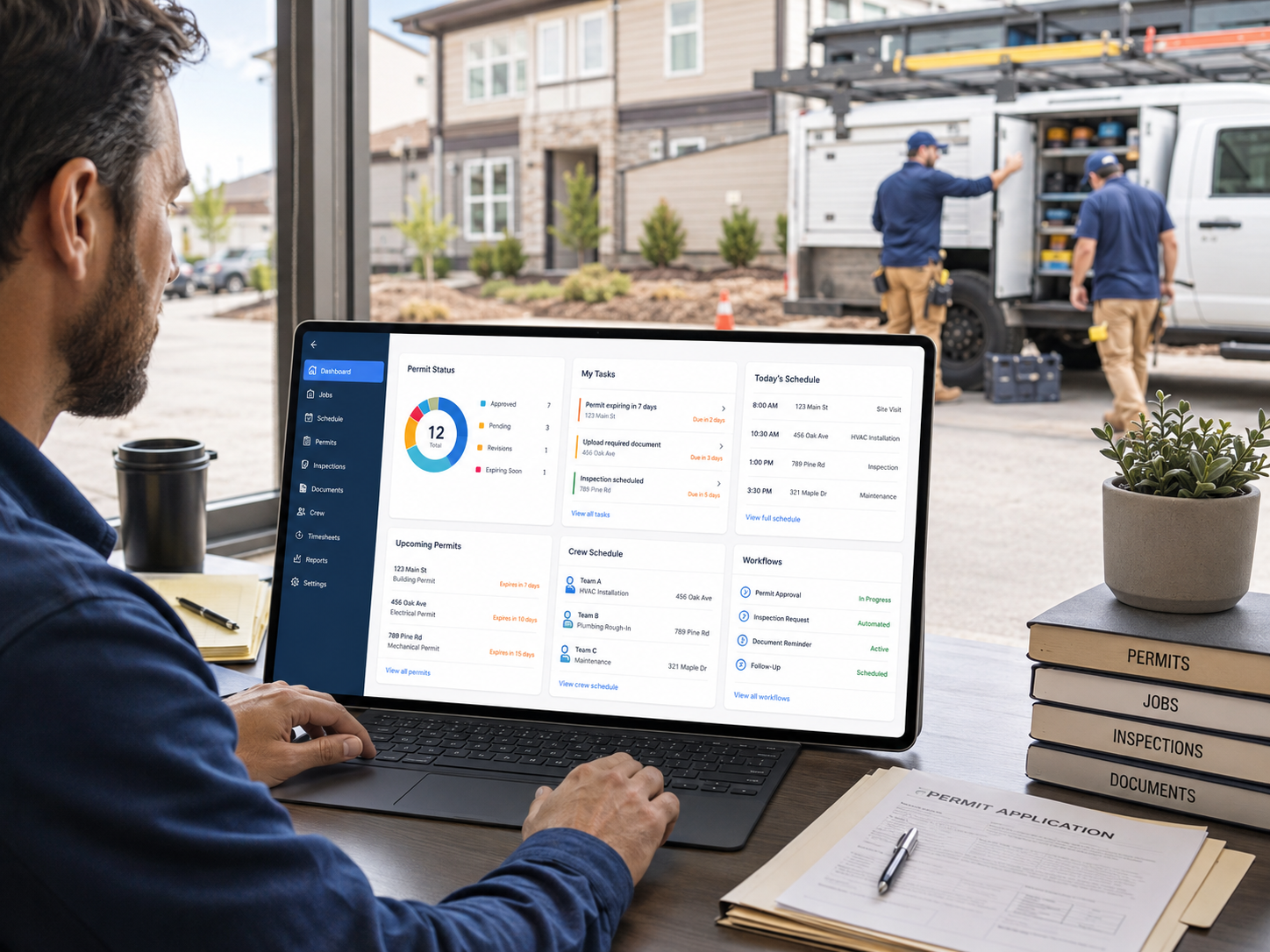
The smartest move you can make is to bring permit tracking and job documentation into the same platform your team uses every day. Field service management software gives you a complete job lifecycle view, so permit status is not floating in someone's email inbox or on a sticky note in the truck.
Here is what a well-configured FieldServ AI setup actually does for permit management and compliance workflows:
- Job-level documentation storage: Every permit application, inspection checklist, and approval document lives inside the job file, accessible from the field via the mobile app.
- Automated task reminders: The system flags when a permit has been applied for but not yet approved, so jobs are never dispatched before compliance is confirmed.
- Photo and notes documentation: Field techs capture job-site photos and notes that satisfy inspection requirements without anyone driving back to the office to print anything.
- Digital signatures: Customer authorizations and compliance acknowledgments are collected on mobile, by email, or in person, so there is never a "we're waiting on the signature" excuse holding up a permit submission.
- Smart scheduling with double-booking prevention: When a permit delay pushes a job, the platform helps you reschedule without creating conflicts across your entire crew calendar.
- Workflow automation: Trigger follow-up alerts to customers and internal staff when a permit milestone is hit or missed, so everyone is on the same page without a single phone call.
That last point matters more than people realize. A big part of permit-related chaos is communication breakdown, not just paperwork. When customers do not know why their job is delayed, they panic, call competitors, and sometimes cancel. Automated arrival alerts and SMS updates from your field service app keep them informed without consuming your admin team's entire day.
The Real Cost Breakdown: What Permit Delays Actually Steal From You
Let's put real numbers on this. The U.S. Bureau of Labor Statistics reports that median hourly wages for construction and extraction occupations exceed $23 per hour nationally, with skilled trades like electricians and plumbers pushing well above $30. If a permit delay idles a two-person crew for two full days, you are looking at $960 to $1,200 in direct labor cost alone before you add in equipment, truck costs, or subcontractor commitments.
Add to that a missed job slot you could have filled with a different project, a customer who cancels due to frustration (taking their referral potential with them), and the administrative time your office burns rescheduling everything. The $5,000 threshold is not just realistic; it is often conservative for a mid-sized operation running multiple crews.
If permit delays are already costing you money this season, you might also want to read about how May Invoice Delays: Field Service Management Software Fixes Slow Pay to understand the full cash flow picture. Delays compound fast when billing also lags behind.
What HVAC, Plumbing, and Electrical Contractors Should Do Right Now
If you are running hvac business software, plumbing business software, or any kind of contractor crm software that does not include job lifecycle tracking and document management, you are missing the tools that prevent permit-related revenue loss.
Here is a practical action plan you can start this week:
- Audit your current permit workflow. Write down every step from job sold to permit approved. Count how many of those steps rely on email, phone calls, or paper. That number is your delay risk.
- Centralize all job documents. Every permit application, inspection report, and customer sign-off should live in one job file, not scattered across email threads and clipboards.
- Build permit status into your dispatch process. No permit approval, no dispatch confirmation. This single rule eliminates the most common and most costly mistake in the cycle.
- Automate customer communication. Set up automated SMS or email updates so customers know exactly where their job stands without having to call you and eat your admin team's time.
- Use your data. Track how often permit delays are affecting your schedule and your revenue. If you cannot measure it, you cannot fix it.
Tools like a solid field service CRM make steps two through five almost automatic. The FieldServ AI automation tools are designed specifically to handle this kind of operational complexity without adding headcount.
And if you are thinking this level of software is only for bigger operations, that assumption is worth challenging. Check out Myth Busted: Solo Contractors Need Field Service Management Software for a perspective that might change how you think about your own setup.
Protecting Your Crew and Your Reputation Through the Chaos
Permit problems do not just cost money; they cost trust. A customer who watches your crew show up, stand around, and then leave because the permit was not ready is not likely to leave a five-star review. They are more likely to leave a frustrated one-star review that follows your business online for years.
With field service management software, you can stay ahead of that scenario by catching permit gaps before the crew ever loads the truck. Combine that with automated review requests after successful job completions and you start building a reputation that reflects the quality of work you actually do, not the chaos of a preventable administrative mistake.
The same discipline that protects you from permit delays also protects your team. When jobs are properly staged, documented, and communicated, your crew is less likely to scramble, make costly on-site decisions without proper authorization, or burn out from constant firefighting. If workforce stress is also on your radar this season, May Workforce Burnout: Field Service Management Software Prevents $8K+ Turnover is a must-read companion piece.
The businesses that thrive in peak season are not the ones with the most trucks or the lowest prices. They are the ones that run the tightest operations. You can explore the full platform at FieldServ AI solutions and see exactly how these tools fit your trade.
Frequently Asked Questions About Permit Delays and Field Service Software
Q: Can field service management software actually track permit status, or is that a manual process?
Most platforms, including FieldServ AI, allow you to attach documents and set task reminders tied to permit milestones. You can flag a job as "awaiting permit approval" and trigger automated internal alerts when that status has not changed after a set number of days. It does not replace the permitting office, but it ensures nothing falls through the cracks on your end.
Q: What is the most common reason permit delays turn into big financial losses for contractors?
The biggest factor is poor communication, both internally between office and field, and externally with the customer. When no one is monitoring permit status in real time, crews get dispatched prematurely, customers are left in the dark, and rescheduling becomes a domino effect that kills productivity for days.
Q: Does this kind of software work for small operations with just one or two technicians?
Absolutely. In fact, solo operators and small crews often benefit the most because they have the least administrative capacity to absorb permit-related chaos. A field service app handles the organization that would otherwise require a dedicated office manager.
Q: How does digital signature functionality help with permits specifically?
Many permit applications require homeowner authorization before submission. Digital signatures collected via mobile or email allow you to get that sign-off immediately after the estimate is approved, rather than waiting days for a paper form to make its way back to you. That alone can shave a week off your permit timeline.
Q: How do I get started with FieldServ AI if I want to tighten up my permit and job documentation workflow?
The fastest way is to reach out directly and walk through your current process with the team. You can connect through Contact Us at FieldServ AI and get a look at how the platform maps to your specific trade and workflow challenges.
Tags
Written by
FieldServ AI Team
Field service management insights from the FieldServAI team.
Related Articles

The August Margin Leak: Why Peak Season Kills Profit
Contractors lose margin in busy months, not slow ones. Here are four peak-season leaks that never reach your revenue report, the math behind them, and why weekly margin review beats a monthly close.

Field Service Management Software: Set It Up in 48 Hours, No IT
Think field service management software needs IT skills? Myth busted. Here's the exact 48-hour, no-code setup plan solo contractors use to go live.
June No-Shows Cost $7K+: Field Service Management Software Fix
June no-shows can cost field service pros $7K+ a month. Here are 3 field service management software features that stop them before 2 PM.
See FieldServ AI in Action
Get a personalized demo and see how AI-powered field service management can transform your business.
Book Your Demo