
3 Metrics Field Service Management Software Must Track in May
May is when seasonal demand shifts can make or break your year. These 3 metrics, tracked with the right field service management software, keep you ahead.
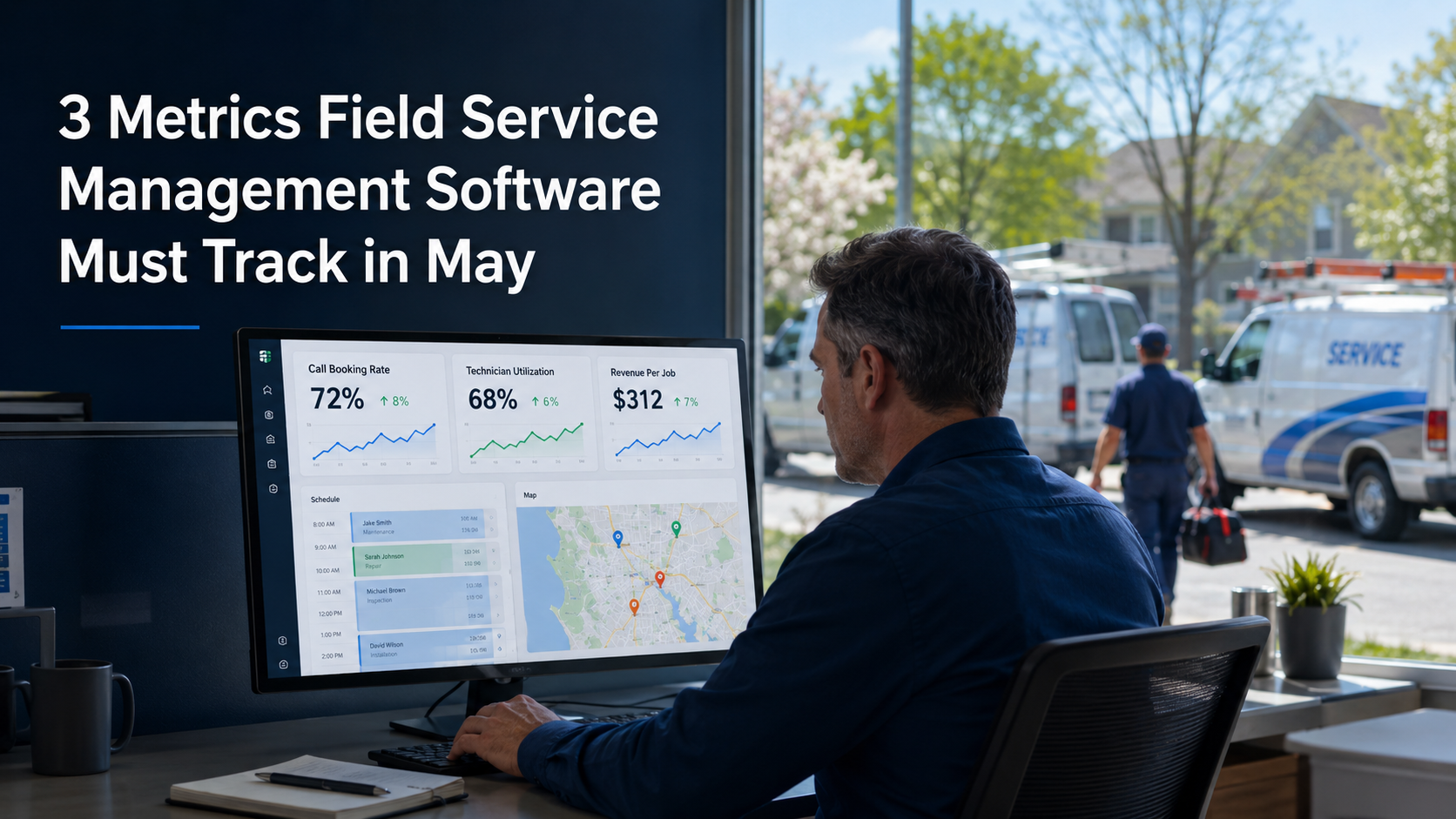
May is not just another month on the calendar for field service contractors. It is the month where seasonal demand either breaks your schedule or breaks your bank account, and if you are not watching the right numbers, you will not know which one is happening until it is too late. The right field service management software does not just help you run jobs; it tells you what your business is actually doing in real time so you can respond before a demand shift turns into a revenue crisis.
Spring is when HVAC techs start getting crushed with cooling tune-ups, plumbers get flooded with outdoor line requests, landscapers are running three crews and still turning away work, and roofers are chasing storm leads from the last week of April. This surge feels great until it does not. When you are too busy to track the right metrics, you end up double-booked, under-billed, and burning out your best guys.
Here are the three metrics every field service contractor needs to track this May, and exactly how to use them before the summer wave hits.
Why May Is the Pivotal Month for Field Service Businesses
May sits at a unique inflection point. It is late enough in the season that you have real demand data coming in, but early enough to still adjust your capacity, pricing, and staffing before June locks everything in. The U.S. Bureau of Labor Statistics tracks seasonal employment patterns through monthly payroll surveys of 119,000 businesses representing 622,000 worksites, and those patterns consistently show that service-sector labor demand spikes between May and July. If you are not watching your own metrics in parallel, you are flying blind during the most consequential stretch of your year.
The field service industry itself is not slowing down. According to Mordor Intelligence, the Field Service Management market is projected to grow from $5.66 billion in 2025 to $9.87 billion by 2031. That growth is being driven by contractors who are finally treating their operations like data-driven businesses instead of gut-feel enterprises. The ones who win are the ones who know their numbers in May, not in September when it is too late to course-correct.
If you have been relying on spreadsheets to manage your season, you already know the pain of lagging data. For a harder look at why that approach costs you money, check out this breakdown of Field Service Software vs. Excel: 4 Costly Spring Mistakes.
Metric 1: Call Booking Rate and Lead Conversion Speed
Your phone is ringing more in May than it did in February. That is the good news. The bad news is that most contractors are converting far fewer of those calls than they think. According to ServiceTitan's field service metrics research, a typical shop has a call booking rate of 42 percent, meaning they convert slightly more than 4 out of 10 calls into booked jobs. High-performing companies, by contrast, see 25 percent or more annual growth rates, and their booking rates reflect that discipline.
In May, a missed call is not just a missed call. It is a job that went to your competitor down the street. When demand is high, customers are not waiting around for a callback. They are hitting the next number on Google before you even get back to them.
What you need to track this month:
- Total inbound calls vs. booked jobs: If you are converting less than 50 percent, you have a lead-capture problem, not a demand problem.
- Average response time to missed calls: Every minute over five minutes drops your conversion rate significantly.
- Lead source breakdown: Know whether your May leads are coming from referrals, Google, or repeat customers so you can double down on what is working.
FieldServ AI's missed call recovery feature sends an instant text response to any caller you cannot answer, keeping the conversation alive while you are on a job. Combined with the 24/7 online booking portal, your leads can convert themselves even at 9 PM on a Tuesday. That is call conversion working for you around the clock, not just during business hours.
Metric 2: Job Completion Rate and Technician Utilization
More demand means more jobs scheduled. But scheduled is not the same as completed, and completed is not the same as completed profitably. Technician utilization is one of the most overlooked metrics in field service, and May is when gaps in this area get expensive fast.
Utilization measures how much of your technicians' paid time is actually being spent on billable work. If your techs are driving for 40 percent of their day, waiting on parts for another 20 percent, and only turning wrenches for 40 percent, you have a serious efficiency problem hidden inside what looks like a busy schedule.
Here is what to watch in May specifically:
- Jobs completed per technician per day: This is your baseline efficiency number. Track it weekly to spot when a tech's productivity dips.
- Drive time as a percentage of total time: Poor routing in spring leads to technicians crossing each other's paths across town, burning hours and fuel.
- Job rescheduling rate: If you are rescheduling more than 10 to 15 percent of your jobs, your scheduling process has a structural problem that will compound through June and July.
NetSuite's comprehensive field service KPI guide highlights a remarkable example: Intimus International reduced dispatch time by more than 200 hours per week using field service management software. That is not a small efficiency gain. That is a structural shift in how a business operates. For a growing multi-crew contractor, those hours translate directly into additional jobs completed and additional revenue captured without adding headcount.
FieldServ AI's smart scheduling with double-booking prevention and real-time GPS dispatch solves the utilization problem at its root. When your dispatcher can see every technician on a live map and assign the nearest qualified tech to the next job, you eliminate the wasted drive time that eats into your margin all season long. See how these tools work together at FieldServAi.
How Field Service Management Software Turns Metrics into Margin
Tracking metrics is only useful if your tools make it easy to act on what you find. Most contractors are not struggling because they do not care about their numbers. They are struggling because pulling those numbers out of disconnected spreadsheets, paper job tickets, and memory takes hours they do not have in May.
A proper field service management software platform consolidates your operational data into a single dashboard so you can see your booking rate, technician utilization, and revenue pipeline in one view, every morning, before your first cup of coffee is finished. This is the difference between reactive management and proactive leadership of your business.
The technology case is also growing stronger every year. Research from Brocoders on Global Field Service Management Trends for 2026 notes that AI-powered scheduling now creates schedules that reflect seasonal fluctuations and absentee patterns automatically. That means your scheduling tool is not just booking jobs; it is learning from your May data to help you staff and route more intelligently by July.
For solo operators who think this level of tooling is only for large companies, that assumption is worth revisiting. Read Myth Busted: Solo Contractors Need Field Service Management Software for a clear-eyed breakdown of why single-tech operations benefit just as much, and often more, from these platforms.
Metric 3: Revenue Per Job and Average Ticket Value
This is the metric most contractors track the least and regret the most. You can have a fully booked May and still end the month with thinner margins than March if your average ticket value is sliding. Revenue per job tells you whether your pricing is keeping pace with your costs, and whether your techs are capturing every opportunity on every call.
Upselling is not a dirty word. It is a service when done right. An HVAC tech who notices a failing capacitor during a tune-up and mentions it to the homeowner is not being pushy; he is being professional. A plumber who flags corroded shutoff valves during a drain call is providing value. The question is whether your team is consistently doing this, and whether you can measure it.
Key revenue-per-job metrics to monitor in May:
- Average invoice value by job type: Break this down by service category so you can see where your highest-value work is coming from.
- Upsell attachment rate: What percentage of jobs include at least one add-on service or product recommendation?
- Recurring service plan conversion rate: May is the perfect month to convert one-time spring customers into annual maintenance agreements that generate revenue through the fall and winter.
The business case for improving customer experience alongside these metrics is significant. According to McKinsey's research on AI in field services and customer care, 70 percent of aftermarket customers would pay more for faster issue resolution. Speed, professionalism, and follow-through are not just nice to have; they are directly tied to your average ticket value and your repeat rate.
FieldServ AI supports revenue growth through built-in upselling prompts, recurring service plan management, automated review requests after every completed job, and integrated payment collection so you are not chasing invoices while your techs are already at the next call. Explore the full solution set at FieldServAi.
For contractors who are also catching up on the financial side of things, the insights in the April Tax Deadline Crunch: Why Field Service Contractors Need Real-Time Profit Reporting post tie directly into why revenue-per-job tracking matters not just operationally but for your bottom-line reporting as well.
Start Tracking Now, Not in June
The contractors who dominate their local markets in summer are not the ones who got lucky in May. They are the ones who were watching the right metrics when the season turned and made fast adjustments based on what the data told them. Whether you run an HVAC shop, a plumbing crew, a landscaping operation, or a multi-trade remodeling company, these three metrics give you the clearest picture of where your business actually stands right now.
Your call booking rate tells you if you are capturing the demand. Your technician utilization tells you if you are delivering it efficiently. Your revenue per job tells you if you are pricing and selling it profitably. Get all three moving in the right direction this month and you will enter summer from a position of strength instead of scrambling to keep up.
FieldServ AI is built specifically for contractors who are done managing their business on instinct and ready to run it on data. From the field service app your techs use in the field to the field service crm your office team uses to manage customer history and follow-ups, every feature is designed around the real daily problems contractors face. If you are ready to stop guessing and start knowing, Contact Us | FieldServ AI - Field Service Management Software and let us show you what tracking the right metrics actually looks like in practice.
Frequently Asked Questions About Field Service Metrics in May
Q: What is a good call booking rate for a field service contractor?
Most contractors average around 42 percent, meaning fewer than half of inbound calls turn into booked jobs. High-performing contractors push this to 60 percent or higher by using instant text responses for missed calls, 24/7 online booking, and faster follow-up processes. If your rate is below 50 percent during a high-demand month like May, fixing your lead capture process is the fastest way to grow revenue without spending more on marketing.
Q: How do I calculate technician utilization for my crew?
Divide billable hours worked by total hours paid, then multiply by 100. A technician paid for an 8-hour day who spends 5 hours on billable work has a 62.5 percent utilization rate. Industry benchmarks vary by trade, but most profitable operations target 70 to 80 percent. Accurate time tracking with GPS verification, like the tools built into contractor crm software platforms, removes the guesswork from this calculation entirely.
Q: Can a solo contractor benefit from tracking these metrics, or is this just for larger companies?
Solo operators benefit enormously from metric tracking, sometimes more than larger companies because every job and every hour matters more when you have no buffer. A solo HVAC tech who improves their average ticket value by even 15 percent can add tens of thousands of dollars to their annual revenue without booking a single extra job. The right field service app makes this tracking automatic so it does not add to your administrative burden.
Q: What is the easiest way to start tracking revenue per job if I have never done it before?
Start by pulling your last 30 invoices and calculating the average. Then segment them by job type. You will almost certainly find that certain job categories are significantly more profitable than others, and that insight alone should influence how you prioritize your schedule. A field service crm with business analytics and profit reporting built in will automate this process going forward so you always have a current picture without doing manual calculations.
Q: How does field service management software help during seasonal demand surges specifically?
During surges like the May-to-July spring and early summer period, the biggest risks are scheduling errors, technician burnout, missed follow-ups, and underpriced work. Good hvac business software or plumbing business software handles double-booking prevention, automated customer communication, smart routing, and real-time reporting all at once. That means your team can handle higher volume without proportionally increasing errors or administrative overhead. The result is more jobs completed, more revenue captured, and fewer calls to put out after the fact.
Tags
Written by
FieldServ AI Team
Field service management insights from the FieldServAI team.
Related Articles

May Maintenance Contracts: Field Service Management Software Stops Summer Revenue Collapse
May is your window to lock in maintenance contracts before summer peaks. Learn how field service management software prevents the revenue collapse most contractors hit by August.

The Callback Avalanche: 6 Field Service Management Software Features That Prevent $8K in Lost April Revenue
April's callback avalanche costs field service contractors thousands. Here are 6 software features that prevent $8K in lost spring revenue.

The Quote That Knows Your Customer Wins More Spring Jobs
Most contractors quote from what they see. The ones winning more spring jobs quote from what they know. This blog covers CRM-informed estimates, upsell timing, and the quote-to-inventory chain.
See FieldServ AI in Action
Get a personalized demo and see how AI-powered field service management can transform your business.
Book Your Demo