
The Quote That Knows Your Customer Wins More Spring Jobs
Most contractors quote from what they see. The ones winning more spring jobs quote from what they know. This blog covers CRM-informed estimates, upsell timing, and the quote-to-inventory chain.
TL;DR:
Most contractors treat a quote as a price document. The ones closing more spring jobs treat it as the output of everything their system knows about the customer. FMI Construction Survey data found that contractors who send written, professional quotes win up to 30% more jobs than those relying on verbal estimates. PandaDoc's analysis of 2.1 million proposals found that professionally designed templates close at a 32% higher rate than plain-text alternatives. But the biggest close rate driver is not speed or design alone - it is context. A technician who walks into a spring estimate knowing the customer's equipment age, service history, and deferred repairs builds a fundamentally different proposal than one starting from scratch. This blog covers how CRM-informed quoting works, why it changes close rates and average ticket size, and how faster quoting creates a parts demand chain your inventory system needs to keep pace with.
The Gap Between a Quote and a Proposal
There is a difference between a price document and a proposal, and most contractors are sending the former when they should be sending the latter.
A price document answers one question: how much will this cost? A proposal answers three: how much will this cost, why does this customer specifically need it, and what happens if they do not act now? The second and third questions can only be answered when the person building the proposal knows something about the customer before they start typing.
The LeadProspecting AI analysis of spring lead volume documented that HVAC, plumbing, and electrical companies see lead volume increase two to three times during the spring surge. That volume multiplier means a contractor completing 20 estimates per week in April needs a quoting system that maintains quality and context across all 20 - not just the first few where someone remembered the customer's history from a prior visit.
The research on what professional quoting actually produces is consistent. FMI's Construction Survey found that contractors who send written, professional quotes win up to 30% more jobs than those relying on verbal estimates. PandaDoc's A/B testing across 2.1 million proposals found that professionally designed templates close at a 32% higher rate than plain-text or minimally formatted proposals. The same research found that quote automation reduces proposal turnaround from 24-48 hours to under 5 minutes and increases close rates by 25-35%. The speed advantage is real and documented. But speed alone is not the differentiator this blog is about.
What CRM-Informed Quoting Actually Looks Like
Walk into a customer's home cold and you are building a quote from what you can see in front of you. Walk in with a CRM that shows the customer's full service history and you are building a quote that reflects what you know about their specific situation over time.
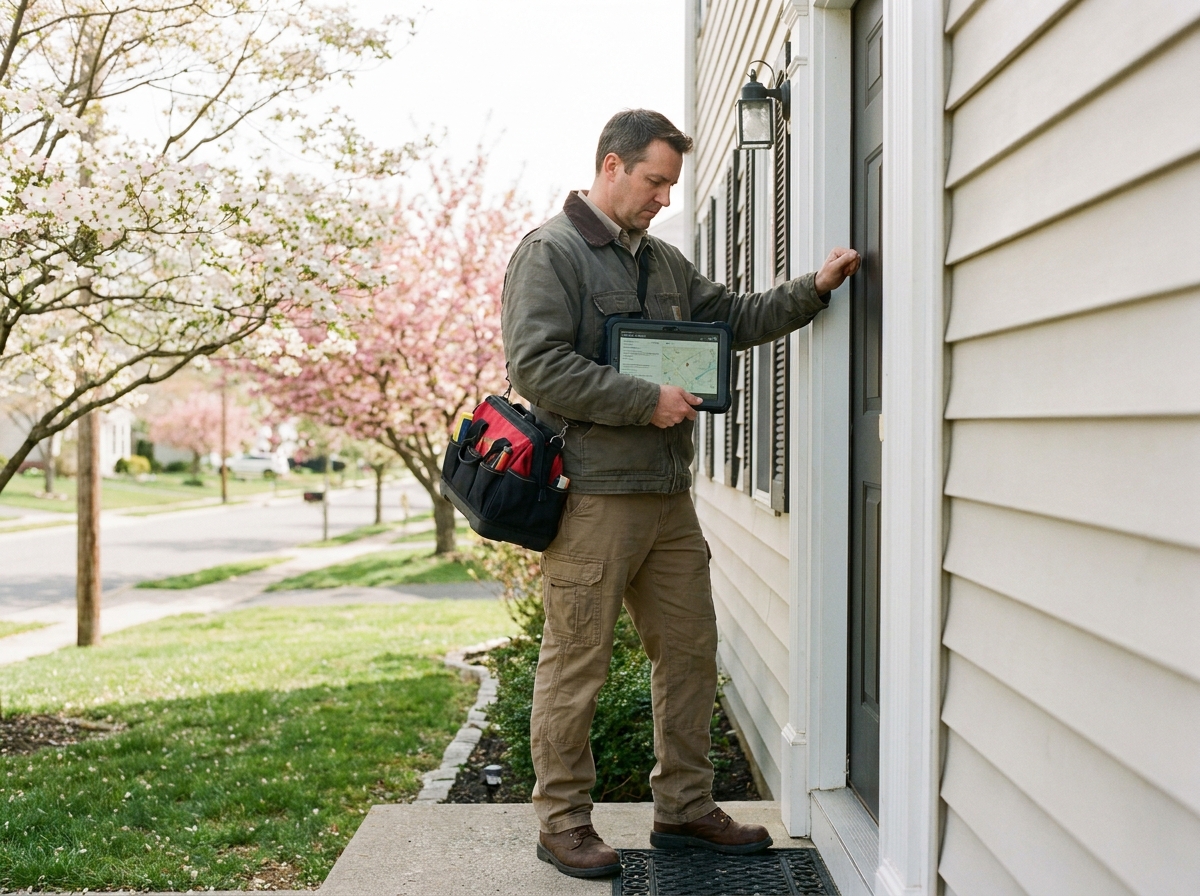
Here is what the difference looks like in practice. A technician dispatched to a spring AC tune-up with no customer context arrives, assesses the system, and quotes the tune-up. A technician dispatched with mobile CRM access arrives knowing that this customer had the same system serviced 18 months ago, that the air handler was flagged as aging during that visit, that the customer mentioned interest in a maintenance plan but did not commit, and that a capacitor was replaced last summer suggesting the system is under increasing electrical stress. Those two technicians are having completely different conversations with the same customer about the same system.
Epsilon's research on customer personalization found that roughly 80% of customers place high value on personalized offers and recommendations, and that tailored communication builds stronger trust and loyalty than generic outreach. In field service, that personalization does not happen through marketing - it happens when a technician walks in informed.
Freshworks' CRM survey of 600 business owners and professionals found that businesses using a CRM are 86% more likely to exceed their sales goals than those without one. 93% of businesses reported higher customer retention since adopting CRM solutions. Mobile CRM specifically is linked to a 65% higher likelihood of achieving sales quotas for field-based teams - because the information that drives the conversation is available at the job site, not back at the office.
The LeadProspecting AI guide on managing the full sales cycle in one platform covers the structural argument: when the system that captures a customer's service history is connected to the system that generates the quote, the proposal reflects real knowledge rather than a fresh start on every visit. That connection is what separates a price document from a proposal.
How Customer Context Changes Close Rates
The behavioral reason context improves close rates is straightforward. A proposal that references the customer's specific situation - their equipment age, their prior service history, the repair that was deferred last fall - signals expertise in a way that a generic price list cannot. The customer is not evaluating a price. They are evaluating whether this technician understands their situation well enough to trust with the work.
Research compiled by Comrade Web on home service industry statistics found that customers are 81% more likely to choose a company that personalizes service. Nearly half of customers say they feel valued when service is personalized, per Invoca research cited in the same compilation. A technician who opens a conversation with "I can see your air handler is coming up on seven years - given the capacitor we replaced last summer, let's make sure we check the contactor while we are here" is delivering exactly that personalization - and it comes from CRM data, not from memory.
Context also changes the conversation about price. A customer who understands why a recommendation is being made - because the technician knows their system's specific history - is significantly less likely to compare that recommendation against a generic competitor quote. The competitor who shows up cold is quoting a different proposal for a different customer, because they do not know what this particular system has been through. That informational advantage is the close rate driver that speed alone cannot replicate.
Businesses adopting CRM see a 300% increase in conversion rates on average, per Zippia's compiled research. Average ROI for CRM spending is $8.71 for every dollar invested. For a field service contractor, the primary conversion event is the signed estimate - and context is the most direct lever available to move that rate.
The Upsell Window That Only Opens With Data
The CRM-informed quote does not just change close rates on the primary job. It opens the upsell conversation in a way that cold quoting never can.
When a technician's mobile app shows that a customer's water heater was installed nine years ago during the same visit when their AC system is being quoted for spring service, the upsell conversation is not a sales pitch. It is a professional observation: "While we are here, I noticed your water heater is approaching the end of its typical service life - would you like us to inspect it while the crew is already on site?" That conversation is natural, relevant, and rooted in data the customer cannot dispute.
Research from CIO and SightCall's field service statistics compilation found that 82% of field service organizations depend on their mobile workers to identify upsell and cross-sell opportunities during service visits. The technicians doing this effectively are not natural salespeople - they are technicians with access to customer history that makes the relevant observation obvious.
The maintenance plan upsell is the highest-value version of this conversation. A customer whose equipment is aging, who has had two service calls in 18 months, and who mentioned a maintenance plan during a prior visit is the most natural maintenance agreement convert available. That conversation requires knowing all three of those things before the proposal is built. The Subscription Maintenance Plans vs. One-Off Service Calls blog covers the revenue math of what a consistent maintenance agreement attach rate means for annual recurring revenue across a customer base of several hundred relationships.
Tiered proposal options amplify this further. A proposal that presents three options - the primary job, the primary job plus a maintenance plan, and a comprehensive package including the flagged water heater inspection - gives the customer three levels of yes rather than a yes-or-no decision on a single price. The customer who might have said no to a flat price often selects the middle option when the alternatives are visible and the rationale for each is grounded in their actual equipment situation.
The Quote-to-Inventory Chain: What Faster Closing Creates Downstream
Here is the operational connection that this blog's differentiated angle makes explicit: every job you close in spring creates parts demand. Faster, higher-volume quoting - especially when it includes upsells and maintenance agreements - generates parts demand faster than a manual inventory system can track.
A contractor closing 30 jobs per week in April through an efficient quoting workflow needs their inventory system to know which parts are committed to which jobs before trucks leave the warehouse in the morning. A contractor closing 20 jobs per week through delayed follow-up quotes has more time between estimate and job completion - which creates a false sense of inventory stability that spring surge will expose.
Aberdeen Group's field service research found that 51% of repeat service visits are caused by insufficient or incorrect parts on site. Each failed first visit costs between $200 and $300 in repeat dispatch. When quote volume increases faster than inventory tracking can keep pace, the jobs your improved close rate wins become the exact jobs that generate repeat-visit costs.
The Spring Rush Ready: 5 Inventory Strategies blog covers how to align your parts stocking with the demand pattern that spring quoting creates. The practical connection: when your quoting system is connected to your job scheduling system, the parts demand for each accepted estimate is visible before the job is dispatched rather than discovered when the technician opens the van at a customer's driveway.
This is the operational argument for a connected platform rather than disconnected quoting, scheduling, and inventory tools. A quote accepted in the field should trigger a parts check against current inventory before the job is confirmed on the schedule. A job scheduled without that check is a job where the 51% repeat-visit failure rate applies regardless of how professionally the estimate was presented.
The Follow-Up System for Jobs Not Closed on the First Visit
Not every job closes on the spot - and that should not feel like a loss. Spring customers are often gathering multiple quotes before committing, which is normal behavior for higher-ticket work. The contractor who follows up most professionally after the estimate visit wins a meaningful share of those jobs regardless of price.
The personalization advantage extends into follow-up. A follow-up message that references the customer's specific quote by name, mentions the specific equipment concern that was identified during the assessment, and includes a direct link to sign the proposal digitally is a different communication than a generic "just checking in on your estimate." The former signals that your business is organized and attentive. The latter signals that you sent the same message to everyone on your list that day.
PandaDoc's research on proposal follow-up found that automated follow-up sequences maintain proposal engagement significantly better than manual reminders - because the timing is consistent and the content references the specific proposal rather than a generic check-in. Automated follow-up at 24 hours, 72 hours, and seven days captures the customers who needed time to think without requiring anyone on your team to remember to send three separate messages per open estimate.
The Close Spring Jobs Faster blog covers how to handle the specific objections that arise during follow-up - price comparisons, financing questions, and scope negotiation - without discounting your way to a lower margin on jobs you would have won at full price.
For the jobs that close through follow-up, the same parts demand chain applies. A job committed on day five of the follow-up sequence is a job that needs parts. That demand needs to be visible in your inventory system the moment the proposal is signed, not when the technician calls the office from the customer's driveway on installation day.
What Changes When the System Knows the Customer
The operational shift described in this blog is not primarily about technology. It is about the difference between walking into a spring estimate as a stranger and walking in as someone who already knows this customer's situation.
The technology - mobile CRM, integrated quoting, connected inventory - is the infrastructure that makes that knowledge available at scale across every estimate your crew completes in April. Without it, the knowledge exists for the first few customers where someone remembered, and disappears for the rest. With it, every technician on every estimate has the same informational advantage that your best-performing tech has on their best days.
The From Handwritten Estimates to Signed Contracts in 10 Minutes blog covers the specific workflow steps that make CRM-informed quoting fast rather than cumbersome - because context is only an advantage if accessing it does not slow down the estimate process.
Ready to Build Estimates That Know Your Customer?
The contractors closing the most spring jobs are not necessarily the fastest or the cheapest. They are the ones whose proposals reflect real knowledge of the customer's situation - equipment history, prior service, flagged concerns - built into a professional estimate delivered before leaving the driveway, with automated follow-up running for every job that does not close on the spot.
FieldServ AI connects customer history, mobile quoting, digital signatures, integrated payment collection, and inventory visibility in one platform. When a technician arrives at a spring estimate, the customer's full service record is on their mobile app before they knock on the door. When the estimate is signed, the job is on the schedule and the parts demand is visible in the inventory system.
Start your free 21-day trial and build your first CRM-linked quote template before the next week of spring estimates starts.
Frequently Asked Questions
How is a CRM-informed quote different from a standard mobile estimate?
A standard mobile estimate builds a proposal from what the technician observes during the current visit. A CRM-informed estimate builds a proposal from what the system knows about this specific customer over time - their equipment age, prior service history, deferred repairs, and previous upsell conversations. The proposal that results from the second approach is specific to that customer rather than generic to that job type. That specificity is what produces the personalization effect that Epsilon research found 80% of customers value highly, and it is the factor that changes both close rates and average ticket size on spring estimates.
What customer history actually matters when building a spring estimate?
The most useful data points for a spring estimate are equipment age and installation date, the service history for that specific equipment including any repairs in the past two years, any flagged concerns from prior visits that were deferred rather than resolved, and any conversations about maintenance plans or upgrades that the customer showed interest in but did not commit to. A technician with those four data points walks into a completely different conversation than one who is seeing the customer's system for the first time.
How does faster quoting create inventory pressure?
Every signed estimate commits parts demand. A contractor closing 30 jobs per week through an efficient quoting workflow needs those 30 jobs' parts requirements visible in their inventory system before trucks leave the warehouse in the morning. When quoting volume increases faster than inventory tracking can keep pace, the jobs that an improved close rate wins become the jobs most likely to generate repeat visits due to missing parts - the single largest cause of field service callbacks per Aberdeen Group research. The connection between quoting speed and parts management is direct and consequential.
Can I use tiered proposal options without it feeling like I am upselling?
Yes, when the options are grounded in the customer's actual situation. Presenting a base tune-up, a tune-up plus maintenance plan, and a comprehensive service package that addresses a flagged concern from a prior visit is not upselling - it is presenting options that are relevant to this specific customer's equipment history. The customer who selects the middle or top option is making a decision based on their situation, not being pushed toward a more expensive choice. The customer who selects the base option is also satisfied because they chose it from a menu rather than being quoted a single price they could not negotiate.
What happens to the follow-up process when a customer does not sign immediately?
An automated follow-up sequence handles the reminders without requiring anyone on your team to track open estimates manually. The sequence sends a reference to the specific proposal - not a generic check-in - at 24 hours, 72 hours, and seven days after delivery. Each message includes a direct link to review and sign the proposal digitally. Your team receives a notification the moment the proposal is opened, signed, or a payment is initiated. The customers who needed a few days to decide are captured by the automation rather than lost because someone forgot to follow up during a busy spring week.
Tags
Written by
FieldServ AI Team
Field service management insights from the FieldServAI team.
Related Articles

The Callback Avalanche: 6 Field Service Management Software Features That Prevent $8K in Lost April Revenue
April's callback avalanche costs field service contractors thousands. Here are 6 software features that prevent $8K in lost spring revenue.

April Is Coming for Your Reputation: Be Ready for It
Spring doubles call volume and doubles every operational gap. FIELDBOSS research shows 38% of homeowners complain about communication, not cost. Here's how to protect your reputation before April peaks.

April Efficiency Audit: Where Your Spreadsheet Fails
A 10-minute, 6-question audit that shows HVAC, plumbing, and electrical contractors exactly where manual systems bleed revenue every spring, with benchmarks and cost math for each gap.
See FieldServ AI in Action
Get a personalized demo and see how AI-powered field service management can transform your business.
Book Your Demo