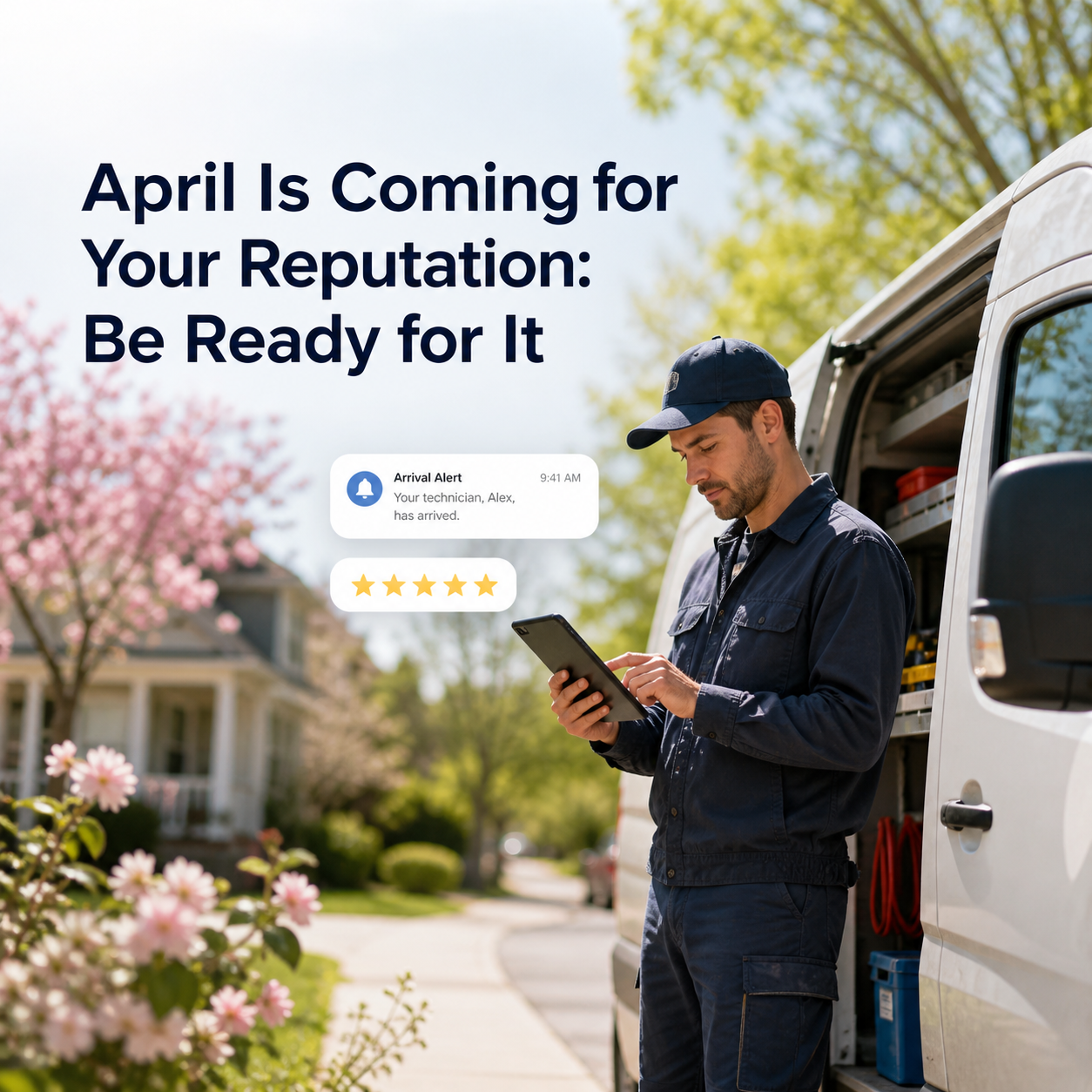
April Is Coming for Your Reputation: Be Ready for It
Spring doubles call volume and doubles every operational gap. FIELDBOSS research shows 38% of homeowners complain about communication, not cost. Here's how to protect your reputation before April peaks.
TL;DR:
Spring doubles your call volume and doubles every gap in your operation - which doubles your complaint exposure. A 2025 FIELDBOSS survey of 1,000 U.S. homeowners found that poor communication and scheduling problems (38%) are nearly twice as likely to frustrate HVAC customers as higher-than-expected costs (21%). Workyard's HVAC statistics compilation found that slowness and unresponsiveness account for 55% of all negative HVAC reviews. Qualtrics XM Institute research found that after a bad service experience, 51% of consumers reduce or stop spending with that brand entirely. This blog covers where spring complaint exposure is highest, how automated systems prevent the specific failures homeowners complain about, and how to turn satisfied spring customers into a review pipeline that compounds month after month.
Why Spring Is Your Highest-Risk Reputation Window
April is simultaneously your highest-opportunity and highest-risk month. Demand spikes, phones ring constantly, and homeowners with urgent HVAC, plumbing, and electrical needs are paying close attention to how your operation handles the pressure.
The research on what actually triggers complaints in field service is more specific than most contractors realize. FIELDBOSS's 2025 survey of 1,000 U.S. homeowners conducted with Pollfish, targeting customers who had hired an HVAC professional in the past 12 months, found that poor communication and scheduling problems (38%) are nearly twice as common a complaint as higher-than-expected costs (21%). The specific failures that most consistently anger customers: difficulty scheduling, vague all-day arrival windows, and no proactive updates about delays or technician status.
Workyard's HVAC industry statistics compilation found that slowness and unresponsiveness account for 55% of all negative HVAC customer reviews - making delays the single largest driver of complaints, ahead of pricing, technical issues, or any other category.
The spring dynamic is what makes these findings matter so much in April specifically. When call volume doubles or triples during a surge week, every communication and scheduling gap doubles with it. A manual dispatch system that produces one double-booking per week produces two during surge. An office that misses 27% of calls on a normal day misses more during peak hours when lines are overwhelmed. The complaint exposure does not grow linearly with volume - it compounds.
The April emergency response blog covers the operational side of handling that surge. The reputation side is what this blog addresses: what happens to your Google profile when the surge exposes the gaps.
The Revenue Math Behind One Bad Review
Before covering the prevention systems, it is worth understanding exactly what is at stake financially when a complaint turns into a public review.
The research on negative review impact is consistent across multiple independent sources. Here is what the data shows:
Metric Finding Source | ||
Customer loss from 1 negative review on Google page 1 | Up to 22% of prospects | Moz Research |
Customer loss from 2 negative reviews on Google page 1 | Up to 44% of prospects | Moz Research |
Revenue reduction for 1-1.5 star rated businesses | 33% less than average | Womply Research |
Revenue increase for businesses responding to 20%+ of reviews | 33% more than average | Womply Research |
Consumers who reduce or stop spending after a bad experience | 51% | Qualtrics XM Institute |
Annual revenue at risk globally from bad customer experiences | $3.7 trillion | Qualtrics XM Institute |
Consumers who avoid a brand because of negative reviews | 94% | Forbes / multiple sources |
Revenue lost per bad review for local businesses | $3,750 to $15,000 | Rsquare Media |
Qualtrics XM Institute's global consumer study, which surveyed 28,400 consumers across 25 countries, found that after a negative experience, consumers reduce or stop spending with that brand more than half the time. That figure rises above 60% in service categories where alternatives are readily available - which describes HVAC, plumbing, and electrical perfectly.
Moz Research's analysis of review impact found that a single negative review on the first page of Google results can drive away 22% of prospects before they ever contact you. Two negative reviews on the first page push that loss to 44%. For a contractor generating 30 inbound calls per week, a 22% reduction means 6-7 fewer leads per week - before accounting for any conversion work.
Rsquare Media's research on local business review economics found that one bad review can result in between $3,750 and $15,000 in lost revenue, accounting for both immediate customer loss and the long-term revenue from customers who would have been referred by the original customer. For a contractor running 200-400 spring jobs per month, even a 2% complaint rate generating a handful of public reviews creates meaningful financial exposure.
Where Spring Complaint Exposure Is Highest
The FIELDBOSS survey identified three specific communication failures that most consistently anger customers. Each one maps directly to a preventable operational gap:
Difficulty scheduling. Complex or slow booking processes were a top complaint. During spring surge, this means homeowners who cannot reach someone or cannot get a confirmed appointment window within a reasonable time frame. Every hour that passes without a confirmed booking is an hour the homeowner is considering competitors.
Vague arrival windows. "All-day" appointment windows were a significant frustration. When a homeowner takes a day off work to be home for a service visit and the technician arrives at 4:45 PM with no prior communication, the job completion does not override the experience of waiting all day. That experience is what goes into the review.
No proactive updates. The absence of information about delays or technician status was the most consistent process complaint. Homeowners do not expect perfection - they expect to be kept informed. A contractor who runs 30 minutes late and sends a text is experienced very differently than one who runs 30 minutes late with no communication at all.
The FIELDBOSS survey president noted: "A simple text message confirming the technician is on their way is more powerful than a 10% discount. Contractors who master communication will own the market."
The scheduling chaos angle connects directly to the manual vs. automated operations comparison. The Manual vs. AI Scheduling blog covers how double-bookings and missed appointment windows - the primary drivers of scheduling complaints - are structural outcomes of manual dispatch, not individual errors. During surge conditions, those structural failures compound.
The Five Systems That Prevent Spring Complaints
Each of the three complaint categories identified by the FIELDBOSS survey - scheduling difficulty, vague arrival windows, and no proactive updates - has a direct operational solution. Two additional prevention systems address the downstream damage when complaints do occur.
Smart scheduling with conflict detection eliminates the double-booking failure before it reaches the customer. When every dispatcher sees the same live calendar and the system flags conflicts before confirming any job, scheduling errors stop being a surge risk. A customer who was never double-booked never has a reason to be frustrated about it.
Automated arrival alerts via SMS eliminate the vague arrival window complaint entirely. A text sent when the technician is 20-30 minutes away tells the homeowner exactly when to expect service. This single touchpoint eliminates the vast majority of "where is your technician?" calls and replaces the frustration of an all-day wait with the satisfaction of accurate, timely communication. The cost of sending an automated text is effectively zero. The cost of the complaint it prevents is not.
Missed call recovery with instant text response closes the gap where spring complaint exposure often starts - the homeowner who calls during a busy period, gets voicemail, and calls a competitor. Invoca's home service call analytics found that home service businesses miss 27% of inbound calls on average, with each missed call costing approximately $1,200 in lost revenue. During surge conditions, that rate climbs to 50-70%. An automated text response within 60 seconds keeps the lead engaged rather than routing them to whoever picks up next.
The GPS geofencing and crew visibility blog covers how real-time crew location data connects to dispatch accuracy - which directly determines whether the arrival time you communicate to a homeowner is actually met.
Job photos, notes, and full customer history in the field prevent the post-job dispute that generates the angriest reviews. When a technician arrives with complete service history on their mobile app and documents every job with timestamped photos and a digital signature, the "I never approved that" conversation is short and resolved in your favor.
Automated review requests after every completed job are the active component of reputation management. Research on review request timing found that 68% of consumers will provide a review for a local business after being asked, and up to 80% of all reviews come from follow-up messages prompting customers to rate their experience. Without a systematic ask, only the most motivated customers leave reviews - and dissatisfied customers are 21% more likely to leave a review without prompting than satisfied ones. Automated requests rebalance that equation.
Building a Reputation That Sells For You Year-Round
Preventing complaints is half the reputation management equation. The other half is actively building review volume that makes individual negative reviews less damaging over time.
The math behind this is straightforward. A contractor with 12 reviews and a 4.2-star average is meaningfully damaged by a single 1-star review. A contractor with 180 reviews and a 4.6-star average absorbs the same review with a fraction of the impact. Review volume is a buffer as much as it is a signal.
Womply's research on Google review economics found that businesses responding to more than 20% of their reviews generate 33% more revenue than average. Responding to reviews - both positive and negative - signals to both Google and potential customers that you are an active, accountable business. For a contractor in a competitive local market, that signal compounds in search ranking over time.
The spring surge creates the single best opportunity of the year to build review volume. High job count, high customer satisfaction from solved urgent problems, and high customer attention to their experience all converge in April and May. A review request sent within 24 hours of a successful spring emergency job reaches a customer who is still relieved and grateful - which is the exact emotional state that produces enthusiastic five-star reviews.
For building the referral pipeline that compounds alongside review volume, the LeadProspecting AI guide on generating more referrals covers how contractors with strong review profiles generate referrals at significantly higher rates - because the review profile is the social proof that makes a referral recommendation credible to the person receiving it.
LeadProspecting AI's automated review and referral systems guide covers how to build these request workflows so they run without manual intervention - which matters during spring when no one has time to remember to ask after every job.
Your Pre-April Reputation Checklist
If spring is approaching and your review automation is not yet configured, here is the order of operations for closing the highest-risk gaps before volume peaks.
First, audit your current scheduling process. If you are dispatching from a whiteboard or a shared calendar without conflict detection, you are one busy week away from a double-booking that generates a public complaint. Smart scheduling with automated conflict detection closes this gap.
Second, set up arrival alert automation. Configure a text trigger that fires when a technician's GPS position indicates they are 20-30 minutes from the job site. This single automation eliminates the vague arrival window complaint - the second-highest driver of field service frustration per the FIELDBOSS survey.
Third, activate missed call recovery. An automated text within 60 seconds of every unanswered call keeps homeowners in your pipeline rather than routing them to a competitor. During spring surge when your answered call rate drops, this is the most direct revenue protection available.
Fourth, enable review request automation. Set the trigger to fire 24 hours after job completion status is marked closed. During spring, this captures customer satisfaction at its highest and builds the review volume buffer that protects you when the occasional complaint does go public.
Fifth, brief your technicians on job documentation. Every spring job should leave your system with photos, notes, and a digital signature. The job documentation that feels like extra work in April is the protection you need in June when a customer disputes a charge.
The Close Spring Jobs Faster blog covers the payment and closing side of spring job completion - which connects directly to reputation, since billing disputes are among the most common triggers of negative reviews.
Ready to Protect Your Spring Revenue Before the Rush Hits?
The contractors who come out of April with a stronger reputation than they entered with are not the ones who had fewer problems. They are the ones with systems that communicated proactively, resolved issues before they became reviews, and captured satisfied customer feedback automatically.
FieldServ AI connects smart scheduling, automated arrival alerts, missed call recovery, mobile job documentation, and review request workflows in one platform built for field service contractors. Each one addresses a specific complaint category from the FIELDBOSS survey. Together they close the reputation gaps that spring surge exposes before a single bad review reaches Google.
Start your free 21-day trial and configure your review automation and arrival alert workflows before the spring surge week starts.
Frequently Asked Questions
Why do customer complaints tend to increase during spring for field service businesses?
Spring is when demand spikes fastest relative to operational capacity. When call volume doubles or triples in a short period, every communication and scheduling gap doubles with it. FIELDBOSS's 2025 survey of 1,000 homeowners found that the top complaint drivers - scheduling difficulty, vague arrival windows, and no proactive updates - are all process failures that worsen under volume pressure. A manual operation that handles scheduling adequately at normal volume develops visible gaps when surge conditions expose its limitations.
How much damage does a single negative review actually cause?
Moz Research found that one negative review on the first page of Google results can drive away up to 22% of prospects. Two negative reviews push that to 44%. Rsquare Media's local business research put the direct revenue loss at $3,750 to $15,000 per bad review accounting for immediate and long-term customer losses. The impact depends heavily on your total review volume - a contractor with 200 reviews absorbs a 1-star review far better than one with 15.
What is the most effective way to get more positive reviews from spring customers?
Ask within 24 hours of job completion. Review research consistently finds that 68% of consumers will leave a review when asked, and up to 80% of all reviews come from follow-up prompts. The timing matters because customer satisfaction peaks immediately after a successful service visit and decays quickly as daily life resumes. An automated review request triggered by job completion status catches customers at the right moment without requiring anyone on your team to remember to ask manually.
Is reputation management relevant for small or solo operations, or only larger companies?
It is arguably more important for smaller operations because there is less review volume to absorb the impact of a single negative review. A solo HVAC contractor with 8 Google reviews and a 1-star complaint has a visibly damaged profile. The same contractor with 80 reviews and a 4.7-star average is far more resilient. The review automation that builds that buffer requires no staff - it runs on job completion triggers while the contractor is focused on the next job.
What should I do if I already have negative reviews online?
Respond to every existing review, positive and negative, within 48 hours. Womply research found that businesses responding to more than 20% of reviews generate 33% more revenue than average. A professional, empathetic response to a negative review does not erase it, but it signals to every future reader that you take feedback seriously and handle problems like a professional business. The most important next step is activating review request automation so positive reviews start building volume around the negative one.
Tags
Written by
FieldServ AI Team
Field service management insights from the FieldServAI team.
Related Articles

April Efficiency Audit: Where Your Spreadsheet Fails
A 10-minute, 6-question audit that shows HVAC, plumbing, and electrical contractors exactly where manual systems bleed revenue every spring, with benchmarks and cost math for each gap.
Mobile vs Desktop Quotes: Field Service Management Software That Closes Jobs Faster in 2026
The window between job walk and signed contract is where most field service revenue is lost. This blog covers mobile vs. desktop quoting, a 5-step closing workflow, and the research behind why speed wins.

HouseCall Pro vs Jobber vs FieldServ AI: 2026 Honest Review
An honest comparison of HouseCall Pro, Jobber, and FieldServ AI across five criteria: missed call recovery, post-job follow-up, quote automation, real pricing, and ease of use for field crews.
See FieldServ AI in Action
Get a personalized demo and see how AI-powered field service management can transform your business.
Book Your Demo