
Mobile vs Desktop Quotes: Field Service Management Software That Closes Jobs Faster in 2026
The window between job walk and signed contract is where most field service revenue is lost. This blog covers mobile vs. desktop quoting, a 5-step closing workflow, and the research behind why speed wins.
TL;DR:
The gap between a job assessment and a signed proposal is where most field service revenue is lost. Velocify research found that responding to a customer inquiry within one minute increases conversion rates by 391% - and the same behavioral logic applies to quote delivery. A homeowner who watched your technician assess their system is most likely to buy in the hours immediately after that visit, not two days later when your desktop quote finally arrives. This blog breaks down exactly when mobile estimates win, when desktop quotes still make sense, and the five-step workflow that closes jobs before competitors can send their first email.
The Window Between Job Walk and Signed Contract
You finish a job walk, shake the homeowner's hand, and tell them you will send over a quote in a day or two. By Tuesday, they have signed with someone else.
This is not a hypothetical. It happens on the majority of delayed quotes in field service, and the behavioral research behind it is well established. Velocify's research on lead conversion timing, analyzing millions of lead records across hundreds of client databases, found that prospects contacted within one minute of their initial inquiry were 391% more likely to convert than those contacted any time after that. Harvard Business Review's analysis of 2,241 U.S. companies found that companies responding within one hour of a customer inquiry were seven times more likely to qualify the lead than those who waited even one additional hour.
The behavioral logic is identical for quote delivery. The moment a homeowner lets your technician into their home to assess a leaking pipe or a failed condenser, their intent to buy is at its peak. That intent decays with every hour that passes. Every hour chips away at their urgency, their memory of why they trusted your crew, and their resistance to calling a second contractor. The quote that arrives two days later is not competing with the job walk. It is competing with a customer who has moved on.
According to Pew Research Center, 91% of U.S. adults now own a smartphone, and their expectations for speed and convenience have carried into every buying decision, including home services. A homeowner who books restaurant reservations, orders groceries, and signs documents from their phone does not understand why a contractor needs two days to send a quote.
What Mobile Estimating Actually Looks Like in Practice
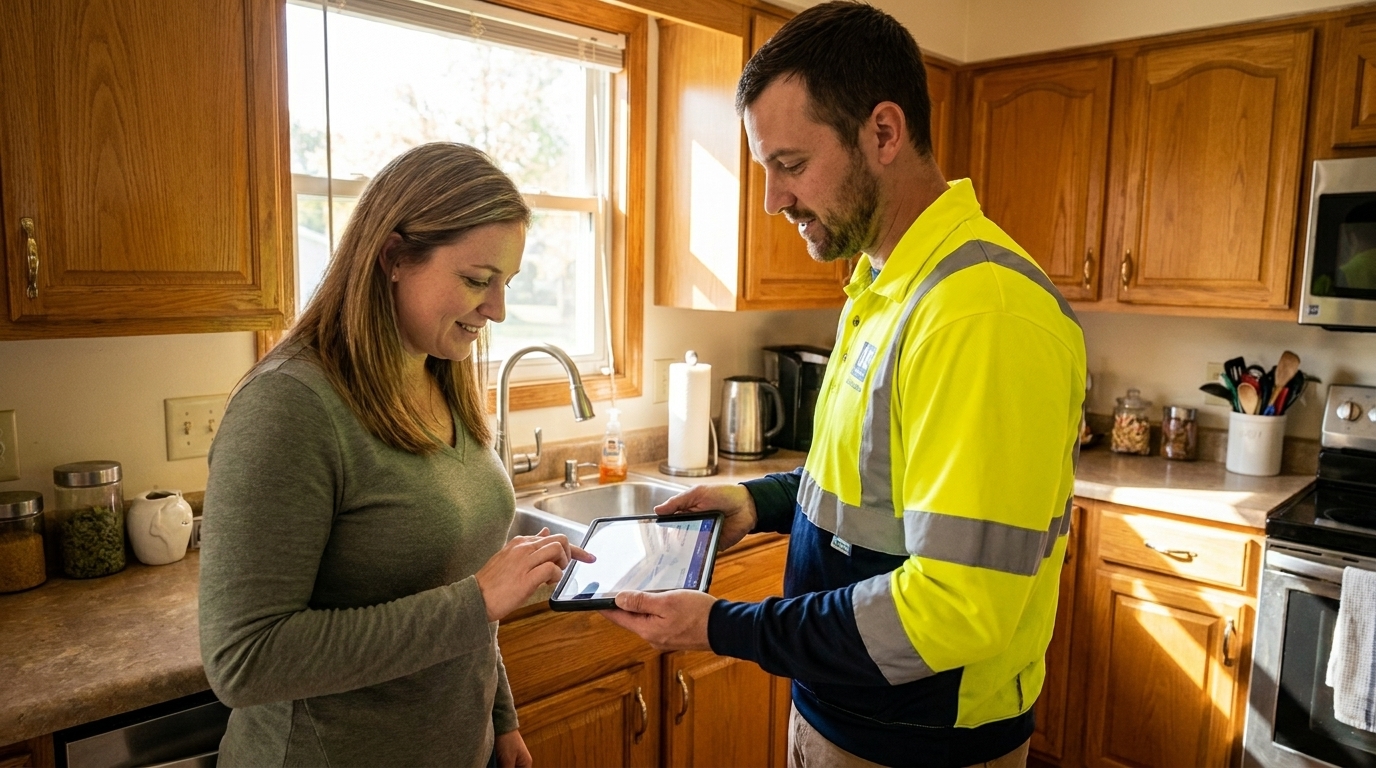
Mobile estimating is not scribbling numbers on a clipboard or texting a ballpark figure. When the workflow is built correctly, a technician can generate a professional, branded proposal with itemized line items, job site photos, optional service packages, digital signature capture, and an integrated payment link before they back out of the driveway.
Here is what a well-built mobile estimate workflow looks like in practice. The technician arrives, completes the job assessment, and photographs the problem areas. They open their field service app, select pre-built service packages or custom line items from a pre-loaded price book, and attach job photos directly to the proposal. Optional upsell items - a maintenance plan, a filter upgrade, an extended warranty - are presented as tiered options rather than add-ons that require a separate conversation. The customer reviews and signs on the technician's phone or via a link sent to their email. A deposit is collected on the spot through integrated payment processing.
That entire process typically takes under 10 minutes for most residential jobs. The From Handwritten Estimates to Signed Contracts in 10 Minutes blog covers the specific steps that make this workflow fast and consistent across a crew of multiple technicians who have varying levels of experience with on-site selling.
The close rate difference between on-site proposals and delayed follow-up quotes is real, even if the specific percentage varies by trade and market. What the research makes clear is the directional argument: the longer the gap between job assessment and proposal delivery, the lower the probability of conversion. This is not a sales skill problem - it is a timing and process problem, and it is solvable with the right tools.
When Desktop Quotes Still Make Sense
Desktop quotes are not obsolete. For large commercial bids, complex remodeling scopes, multi-phase roofing projects, or any job requiring material takeoffs and engineering specifications, taking a day to build a detailed proposal makes complete sense. There are jobs where thoroughness earns more trust than speed, and forcing an on-site close on a $150,000 commercial HVAC installation would be the wrong move.
But here is the honest reality: most residential field service jobs are not that complicated. The average HVAC replacement, drain clearing, electrical panel upgrade, or handyman scope can be quoted accurately on-site with a pre-loaded price book and a well-configured field service app. Waiting until you are back at the office adds delay without adding value for the customer. The customer is not getting a more accurate quote two days later. They are getting the same quote, minus the window when they were most likely to sign it.
Desktop quoting also creates a coordination problem for multi-crew operations. The technician relays job details to the office, an admin builds the quote, it goes through review, and then it finally gets emailed. That is three or four handoffs where information can be misunderstood, numbers can be entered incorrectly, and the customer can be forgotten. Each handoff is an opportunity for the proposal to arrive late or wrong. The LeadProspecting AI analysis of the hidden cost of manual processes documents the same pattern from the lead side: every manual handoff between field and office creates a gap that costs revenue without anyone noticing a single catastrophic failure.
The Upsell Opportunity That Mobile Estimates Unlock
There is a revenue dimension to mobile estimating that goes beyond close rate: the upsell at the moment of highest trust.
Research from CIO and SightCall's field service statistics compilation found that 82% of field service organizations depend on their mobile workers to identify upsell and cross-sell opportunities during service visits. When technicians have access to service history and product data on-site, they can recommend upgrades and maintenance plans in real time based on what they are actually looking at.
This is where the behavioral timing argument applies to revenue growth, not just close rates. The technician standing in front of a homeowner whose 12-year-old HVAC system just needed an emergency repair has a natural opening to present a maintenance plan. The same technician, sending an email two days later, has no opening at all. The urgency that made the homeowner receptive to the conversation has passed.
Field service industry benchmarks compiled by FieldServicely show that high-performing field service companies achieve service contract attach rates of 30-50% - meaning nearly half of service calls convert to a maintenance agreement when technicians present options on-site with real-time pricing tools. That attach rate drops significantly when the conversation happens over email days after the visit. The Subscription Maintenance Plans vs. One-Off Service Calls blog covers the full revenue math of what a 30-50% attach rate means for annual recurring revenue across a customer base of a few hundred relationships.
How Software Bridges the Mobile and Desktop Workflows
The strongest answer to the mobile vs. desktop debate is not choosing a side. It is using a field service platform that supports both workflows seamlessly, depending on job type, and automates everything that happens after the quote is sent.
When a customer does not sign on the spot - which is normal and should not feel like a lost job - the right platform handles the follow-up automatically. They receive a reminder text, then an email, then a final nudge at a defined interval. The field service CRM logs every interaction so nothing falls through the cracks, and the dispatcher knows exactly where every open proposal stands without playing phone tag with three technicians.
The LeadProspecting AI guide on converting leads through a managed sales cycle makes the same argument from the lead side: when the system that captures an inquiry is connected to the system that schedules the job, generates the estimate, and follows up on the proposal, every step reinforces the next. Disconnected tools - one app for scheduling, a different system for quoting, a spreadsheet for tracking open proposals - create exactly the manual handoff gaps that delay quotes and lose jobs.
Research on small business cash flow consistently shows that poor cash flow management is the leading driver of small business failure. Faster quotes mean faster decisions, faster deposits, and faster cash in your account. That is not a small thing when you are managing payroll, material costs, and fuel every week. The Digital Payments blog covers how connecting proposal acceptance to integrated payment collection eliminates the gap between a signed estimate and money in the bank.
Five Steps to Start Closing More Jobs This Week
None of these require overhauling your entire operation. Each one is executable within your current week.
Step one: Audit your current quote turnaround time. Pull your last 20 completed job assessments. How many hours passed between the site visit and the customer receiving a proposal? If the average is more than two hours for a routine residential job, you are losing jobs to contractors who are faster. Count how many of those proposals converted. That is your current baseline.
Step two: Build a standardized price book inside your field service app. Pre-loaded services, materials, and labor rates mean your technicians can quote accurately without calling the office. A price book that requires a call to confirm pricing is a bottleneck that adds 30 minutes to every assessment. A price book accessible from the field app means the technician quotes with confidence on-site.
Step three: Add at least one tiered option to every proposal. Presenting a single price gives customers a yes-or-no decision. Presenting good, better, and best options gives customers a choice between three levels of yes. The customer who might have said no to a single price often says yes to the middle option when the alternatives are visible. This is the same behavioral principle that restaurants use when listing prices from low to high on menus.
Step four: Automate your follow-up sequence. For any proposal not signed on-site, set a 24-hour text reminder, a 72-hour email nudge, and a seven-day final follow-up. Configure these once in your field service CRM and let the system execute them without requiring anyone to remember. The Close Spring Jobs Faster blog covers how to handle the specific objections that arise during follow-up without discounting your way to a lower margin.
Step five: Collect a deposit at signature. Proposals signed on-site with a deposit collected at that moment have dramatically lower cancellation rates than proposals signed later with payment deferred to job completion. Make deposit collection frictionless by connecting it directly to the digital signature step in your field service app. The customer who just signed is in the highest-commitment moment of the sales process - collecting the deposit there, not later, locks in the job.
Ready to Close More Jobs Without Chasing More Leads?
The revenue opportunity in faster quoting is not about generating more leads. It is about converting more of the assessments you are already completing. A technician who completes five job walks per week and converts two of them is doing the same work as a technician who converts four - the difference is entirely in the proposal process.
FieldServ AI connects mobile estimating, digital signatures, integrated payment collection, automated follow-up sequences, and customer history in one platform built for field service contractors. When your technician completes a job assessment, the proposal is ready before the homeowner has shown them to the door.
Start your free 21-day trial and build your price book and proposal templates before the next week of job walks starts.
Frequently Asked Questions
Is it realistic to build an accurate quote on-site for most residential jobs?
For the majority of residential and light commercial field service work, yes. The key is having a pre-loaded price book in your field service app with current labor rates, material costs, and service package options. A technician who can select from pre-configured options rather than calculating from scratch can produce an accurate proposal in under 10 minutes for most routine jobs. Complex commercial bids with engineering specifications may still require desktop review, but those are a small fraction of most residential contractors' weekly volume.
What if the customer wants to think about it before signing?
That is completely normal and not a lost job. The right field service platform sends the proposal to their email immediately and then triggers an automated follow-up sequence - a reminder text, an email nudge, a final follow-up - over the next several days. You receive a notification the moment they open the proposal, sign, or make a payment. The follow-up happens without anyone on your team having to remember to send it.
How do mobile estimates affect customer perception of professionalism?
When generated through a properly configured field service platform with branded headers, itemized line items, job site photos, and a clean digital signature interface, mobile estimates are indistinguishable from office-generated proposals - except that they arrive faster. Most customers react positively to on-site proposals because immediate delivery signals organization, preparation, and respect for their time. A technician who hands over a professional proposal before leaving the driveway communicates competence more effectively than one who promises to follow up by email.
Can I use desktop quoting for larger jobs while switching to mobile estimates for standard jobs?
A solid field service platform supports both workflows in the same system. Technicians send fast mobile quotes for routine jobs while complex projects get built out on desktop with full specification detail. Both types end up in the same proposal dashboard so your team always knows the status of every open estimate without maintaining separate spreadsheets or making status-check calls.
How does faster quoting connect to cash flow?
Faster quotes produce faster decisions, which produce faster deposits, which reduce the gap between completing a job assessment and having money committed to your account. For a contractor managing weekly payroll and material purchasing, the cumulative effect of proposals that close in hours rather than days is a meaningfully shorter cash cycle across the full book of business. Connecting the proposal acceptance step directly to integrated payment collection - so the deposit is collected at signature rather than invoiced separately later - compresses that cycle further.
Tags
Written by
FieldServ AI Team
Field service management insights from the FieldServAI team.
Related Articles

April Is Coming for Your Reputation: Be Ready for It
Spring doubles call volume and doubles every operational gap. FIELDBOSS research shows 38% of homeowners complain about communication, not cost. Here's how to protect your reputation before April peaks.

April Efficiency Audit: Where Your Spreadsheet Fails
A 10-minute, 6-question audit that shows HVAC, plumbing, and electrical contractors exactly where manual systems bleed revenue every spring, with benchmarks and cost math for each gap.

HouseCall Pro vs Jobber vs FieldServ AI: 2026 Honest Review
An honest comparison of HouseCall Pro, Jobber, and FieldServ AI across five criteria: missed call recovery, post-job follow-up, quote automation, real pricing, and ease of use for field crews.
See FieldServ AI in Action
Get a personalized demo and see how AI-powered field service management can transform your business.
Book Your Demo