
May Weather Emergencies: 7 Field Service Management Software Features That Prevent $10K+ in Missed Spring Storm Jobs
Spring storms create massive demand spikes. Discover 7 field service management software features that help contractors capture $10K+ in missed storm jobs.
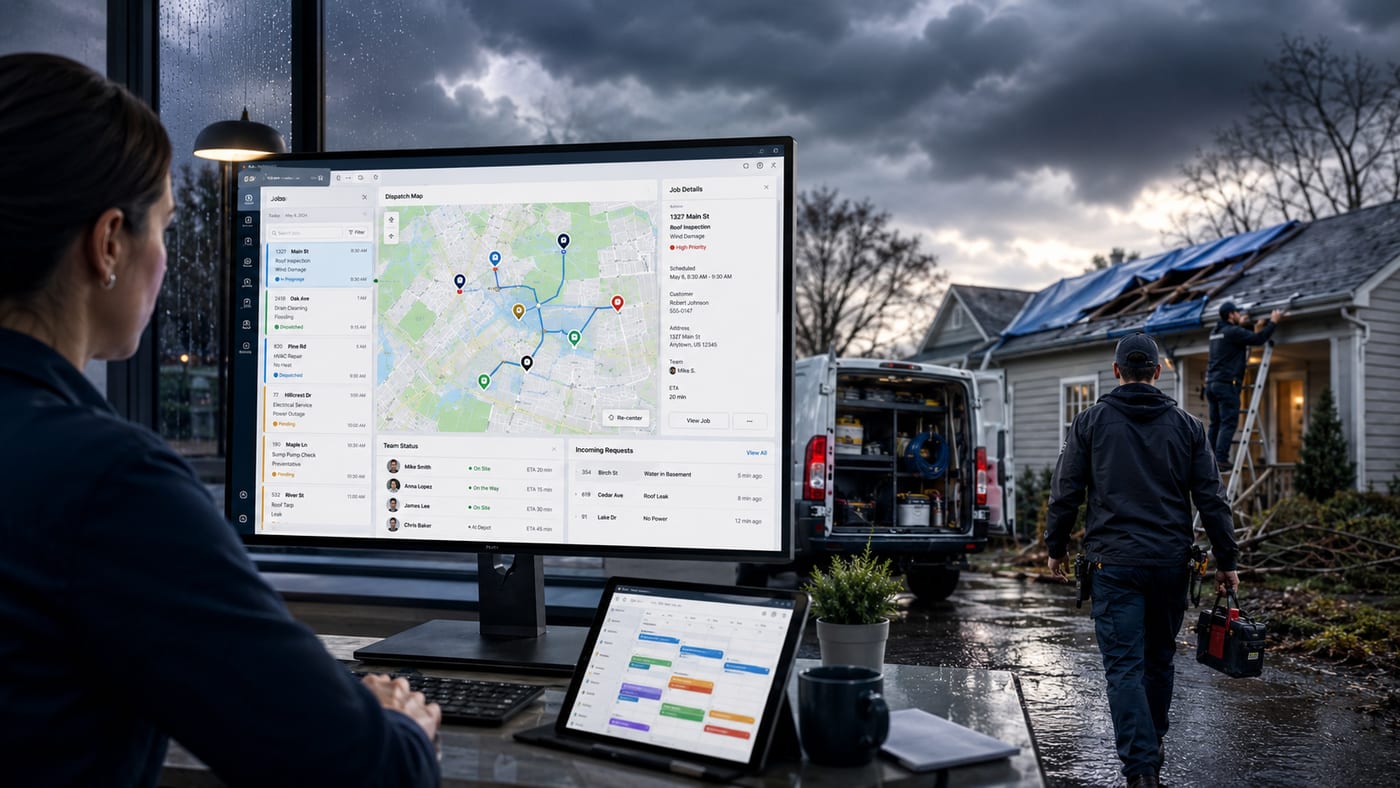
Spring Storms Are Here. Is Your Business Ready to Cash In or Get Left Behind?
If you run an HVAC, roofing, plumbing, or electrical business, you already know what May looks like: phones blowing up, crews stretched thin, and jobs slipping through the cracks faster than water through a damaged roof. The right field service management software is the difference between capturing that surge and watching your competitors scoop it up while you're buried in sticky notes and missed calls.
Here's what makes this urgent. According to Insurance Business Magazine, insured losses from U.S. severe convective storms had already reached $42 billion through September 2025, with average per-event costs running 31% higher than the previous decade. That's not just a homeowner problem. That's a massive, recurring wave of demand for every contractor who's positioned to answer it.
The contractors who win during storm season aren't necessarily the most skilled. They're the most organized. Let's break down the seven features that keep the money flowing when chaos hits.
Why Storm Season Exposes Every Crack in Your Operation
A calm Tuesday in March is forgiving. You can get away with a whiteboard schedule, a few phone tags, and mental notes about who owes you what. But a May storm system that rolls through three counties on a Friday afternoon? That's a stress test your old system will fail.
The National Centers for Environmental Information reports that from 1980 through 2024, the U.S. experienced 403 confirmed weather and climate disaster events each exceeding $1 billion in losses, including 203 severe storm events specifically. These aren't once-a-decade flukes. They're a predictable, growing part of your business calendar.
When demand spikes by 300% overnight, the businesses with automated workflows and real-time visibility capture the jobs. The ones running on gut instinct and group texts lose them. Here's what separates the two groups.
The 7 Field Service Management Software Features That Protect Your Spring Revenue
- Smart Scheduling with Double-Booking PreventionWhen 40 calls hit in 24 hours, double-booking isn't a question of if, it's when. Smart scheduling inside a field service app like FieldServ AI automatically flags conflicts, fills open slots, and assigns jobs based on crew location and availability. No more calling a customer back to say "sorry, we're already booked" after they've already called someone else.
- Real-Time Dispatch and GPS Job TrackingStorm jobs don't run on a polite 9-to-5 schedule. You need to see where every technician is, route the closest available crew to a new emergency, and update customers without picking up the phone. Real-time GPS dispatch cuts response time and keeps your team moving efficiently across a high-volume day.
- Missed Call Recovery with Instant Text ResponsesEvery missed call during a storm is a job offer handed to your competitor. FieldServ AI's missed call recovery fires an automatic SMS response the moment a call goes unanswered, keeping that homeowner engaged until your team can follow up. If you've ever lost a $2,000 roof inspection because someone called while your hands were full, you know exactly what this feature is worth. This pairs well with what we covered in The Callback Avalanche: 6 Field Service Management Software Features That Prevent $8K in Lost April Revenue.
- Professional Customizable Quotes and Digital SignaturesStorm customers are anxious and ready to spend, but they're also shopping fast. If your estimate process takes two days and requires a second trip, you'll lose the job to whoever closes on the spot. A solid field service CRM lets your tech build a professional, branded quote on a tablet at the job site and collect a digital signature in under five minutes. No printing, no faxing, no delay.
- For a deeper look at how mobile quoting closes more deals in less time, check out Mobile vs Desktop Quotes: Field Service Management Software That Closes Jobs Faster in 2026.
- Job Photos and Notes DocumentationStorm damage claims are documentation-heavy. Homeowners need photos for insurance. You need proof of conditions before and after work. A field service app that lets your tech snap photos, add time-stamped notes, and attach everything directly to the job record protects you legally and speeds up the insurance approval process for your customer. Faster approvals mean faster payment.
- Automated 5-Star Review RequestsStorm season is your best window to build your online reputation fast. When you complete a job well under pressure, that customer is primed to leave a glowing review. FieldServ AI automatically sends a review request after job completion, while the experience is still fresh. Even converting 20% of your storm jobs into 5-star reviews can dramatically change how you rank on Google before next season hits.
- Integrated Payments and Automated CollectionsCash flow is everything during a surge. You're buying materials, paying overtime, and juggling fuel costs all at once. Integrated payments let customers pay by card, ACH, or financing right from their phone, and automated collections follow up on any unpaid invoices without you chasing anyone down. According to NOAA Climate.gov, 2024 alone saw 27 separate billion-dollar weather disasters across the U.S. That's 27 demand spikes where contractors with fast payment tools collected faster and reinvested faster.
What the Numbers Actually Mean for Your Bottom Line
Let's put a real number on this. Say a storm rolls through your market and generates 60 emergency service calls over 72 hours. Without automated scheduling and missed call recovery, a small operation realistically captures maybe 35 of those. At an average ticket of $650, that's $22,750. With the right contractor crm software in place handling intake, scheduling, quoting, and follow-up automatically, the same team could capture 50 or more of those calls. That's $32,500. The difference is over $10,000 from a single storm event, with the same crew.
And that's a conservative scenario. Roofing contractors in Texas saw this play out in real time. Spring severe weather events in April and May 2024 resulted in disaster declarations across 29 counties in Texas, requiring recovery assistance from multiple state agencies, as documented by Disability Rights Texas. Contractors in those counties who were operationally ready captured months of revenue in days.
This is also why staff burnout spikes so hard after storm season. The team is manually handling everything that software should automate. If you want to understand how to protect your crew while scaling through demand, read our breakdown on May Workforce Burnout: Field Service Management Software Prevents $8K+ Turnover.
How FieldServ AI Handles the Full Storm Job Lifecycle
What makes hvac business software or plumbing business software actually useful in a crisis is not any single feature. It's whether those features talk to each other. A GPS dispatch tool that doesn't sync with your schedule is just a second screen to manage. A quote tool that doesn't connect to payments means more manual steps at the worst possible moment.
FieldServ AI is built as a complete job lifecycle platform. From the moment a storm customer hits your online booking portal at 11pm, through dispatch, on-site quoting, digital signature, photo documentation, payment collection, and automated review request, every step flows without you touching it. You can explore the full feature set at FieldServAi or see how the platform fits different business types at FieldServAi.
The workflow automation layer is especially valuable during surges. Pre-built follow-up sequences, arrival alerts, and payment reminders run in the background while your team focuses on the actual work. You can see how those automations are structured at FieldServAi.
Want to calculate what better software could actually be worth to your specific business? The Field Service Management Software ROI Calculator: Stop Leaving Money on the Table walks you through it with real numbers.
Stop Leaving Storm Revenue on the Table
May is not a month to be figuring out your process. The storms are coming whether you're ready or not. The question is whether your operation is built to capture the demand or whether it collapses under the pressure and hands those jobs to a competitor who is.
The seven features above are not luxury add-ons. They are the operational baseline for any field service business that wants to grow through high-demand periods instead of just surviving them. And the math is simple: if better software helps you capture even five additional storm jobs per season at $1,500 average ticket, that's $7,500 in revenue you were previously leaving behind, every single year.
If you're ready to see what FieldServ AI can do for your storm season prep, Contact Us | FieldServ AI - Field Service Management Software and let's walk through it together. The next storm isn't waiting.
Frequently Asked Questions About Field Service Management Software and Storm Season
Q: How quickly can I get FieldServ AI set up before storm season hits?
Most contractors are fully operational within a few days. The onboarding process is designed for busy field service businesses, not IT departments. Core features like scheduling, dispatch, and automated messaging can be live within 24 to 48 hours, with more advanced integrations like QuickBooks sync and custom workflow automation following shortly after.
Q: Does field service management software actually help with insurance documentation?
Absolutely. The job photos and notes feature creates a time-stamped, organized record attached directly to each job. That documentation helps homeowners submit insurance claims faster, which speeds up your payment and builds serious trust with the customer. Contractors who make the insurance process easier consistently get more referrals from storm jobs.
Q: What if I'm a solo operator? Is this software too much for one person?
Solo operators often benefit the most because every automated task replaces something you would have had to do manually at 10pm. Missed call recovery, automated review requests, and payment reminders alone can reclaim several hours a week. The platform scales with you, so it works whether you're running solo today or managing five crews next year.
Q: Can the field service app handle emergency same-day scheduling without creating chaos?
Yes, and that's one of its strongest use cases. The smart scheduling engine with double-booking prevention was built specifically for high-volume, fast-moving days. It shows real-time crew availability, flags conflicts automatically, and lets dispatchers slot emergency jobs without disrupting existing commitments. During a storm surge, that visibility is the difference between organized growth and operational breakdown.
Q: Is there a way to see if storm-season jobs are actually profitable after material and labor costs?
FieldServ AI includes Business Analytics and Profit Reporting that breaks down job-level profitability, not just revenue. You can filter by job type, crew, or time period to see exactly which storm jobs made money and which ones ate into your margins. That data is how you price smarter going into the next storm season.
Tags
Written by
FieldServ AI Team
Field service management insights from the FieldServAI team.
Related Articles

Field Service Management Software: 6 Fixes for June Revenue Leaks
June is your busiest and leakiest month. Here are 6 field service management software features that stop revenue leaks and keep multi-crew operations profitable.

The August Margin Leak: Why Peak Season Kills Profit
Contractors lose margin in busy months, not slow ones. Here are four peak-season leaks that never reach your revenue report, the math behind them, and why weekly margin review beats a monthly close.

Field Service Management Software: Set It Up in 48 Hours, No IT
Think field service management software needs IT skills? Myth busted. Here's the exact 48-hour, no-code setup plan solo contractors use to go live.
See FieldServ AI in Action
Get a personalized demo and see how AI-powered field service management can transform your business.
Book Your Demo