
May Equipment Failures: Field Service Management Software Stops $10K+ Downtime
Equipment failures in May cost field service businesses thousands. Here are 5 ways field service management software stops the damage before it starts.
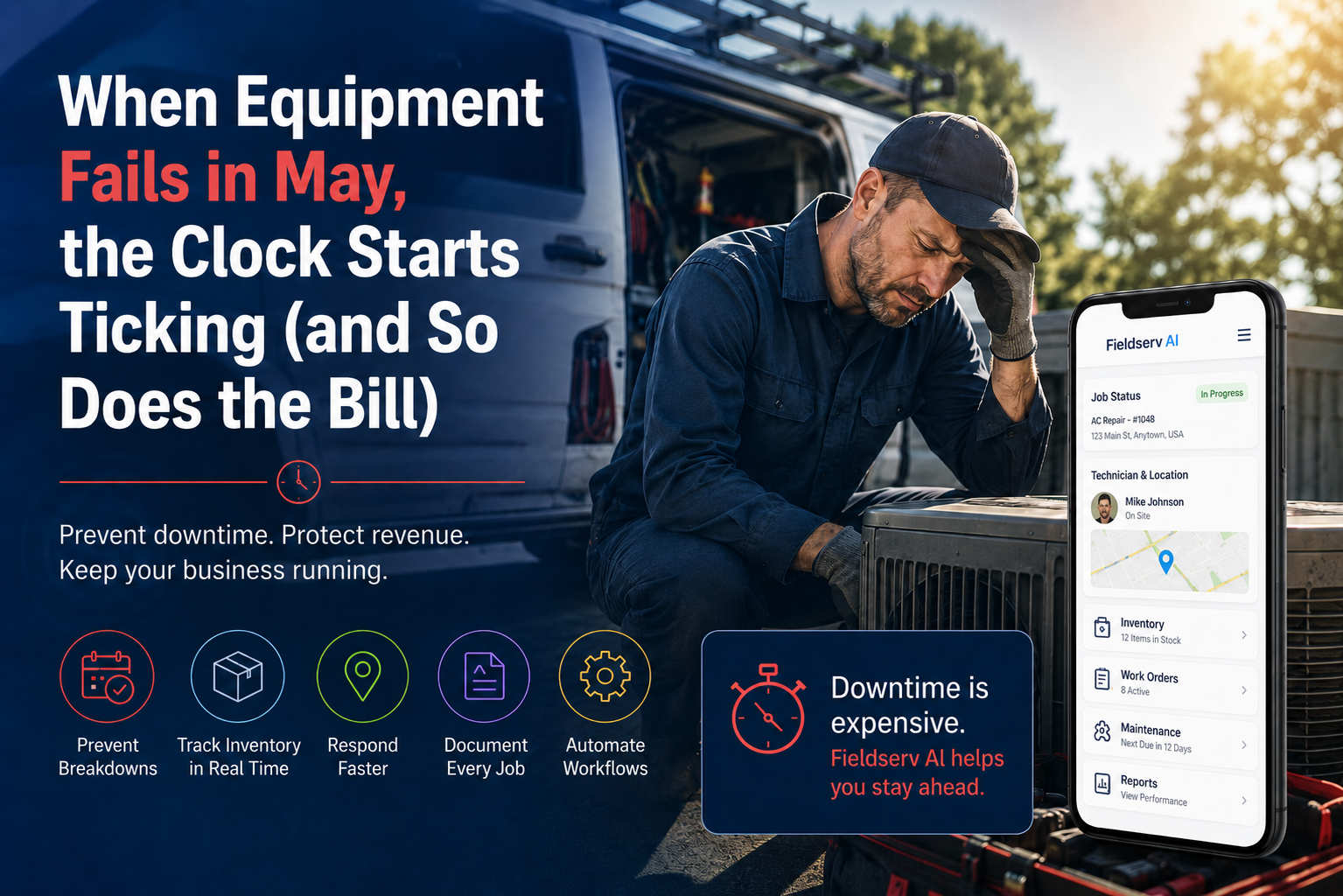
When Equipment Fails in May, the Clock Starts Ticking (and So Does the Bill)
May is crunch time. Phones are ringing, crews are stretched thin, and the last thing any contractor needs is a busted piece of equipment sitting idle on a job site. If you're running HVAC calls, plumbing jobs, or landscaping routes without field service management software, you're essentially flying blind when something breaks down.
Here's the reality: according to Reliamag's industry research, discrete manufacturers lose between $10,000 and $50,000 per hour from unplanned downtime, and 42% of those incidents are caused by equipment failure. That's not big-factory numbers that don't apply to you. A single service vehicle out of commission, a compressor that dies mid-job, or a faulty piece of diagnostic equipment can crater a week's worth of revenue for a small crew.
The contractors who survive May's chaos aren't just lucky. They've built systems that catch problems before they become emergencies. Here are five specific ways the right software keeps equipment failures from turning into five-figure disasters.
Way 1: Preventive Maintenance Scheduling That Actually Gets Done
Most contractors know they should do preventive maintenance on their vehicles and tools. Almost nobody actually does it consistently, because it falls through the cracks between job bookings, customer calls, and payroll.
A solid field service management platform lets you schedule recurring maintenance tasks the same way you schedule customer jobs. Set a reminder every 3,000 miles for your service van. Flag a compressor for inspection every 90 days. When that date hits, it shows up on the dispatch board just like any other job, and it doesn't get ignored.
A peer-reviewed study published in ScienceDirect confirmed that integrating condition-based maintenance practices significantly increases machine uptime and reliability while simultaneously reducing overall maintenance costs. The contractors seeing those results aren't doing anything magical. They're just being consistent, and software makes consistency automatic.
Way 2: Real-Time Inventory Tracking Prevents the "Wrong Part" Disaster
Here's a scenario that costs field service businesses thousands every spring: a tech drives 45 minutes to a job, pulls the unit apart, and realizes they don't have the right part on the truck. Now you've got labor hours wasted, a frustrated customer, and a rescheduled job that bumps someone else back.
Real-time inventory management inside a field service app fixes this. When a part gets used on a job, the system updates stock counts automatically. When levels drop below your set threshold, it triggers a purchase order before anyone has to notice. Your techs show up with what they need because the software already handled the reorder two days ago.
This isn't just convenience. A missing part on a critical May AC job can mean losing a customer entirely, especially if a competitor picks up the callback. Multiply that by three or four jobs a week and you're looking at serious revenue leakage.
Way 3: GPS Job Tracking Cuts Emergency Response Time in Half
When a crew reports equipment trouble in the field, your ability to respond quickly depends on knowing exactly where everyone is right now. Not where they were scheduled to be. Where they actually are.
Real-time dispatch and GPS tracking built into your field service management software gives dispatchers a live map of every crew and vehicle. When a van breaks down or a piece of equipment fails mid-job, you can immediately see which other technician is closest and reroute them without a string of phone calls.
According to Siemens' True Cost of Downtime 2024 report, plants average 25 downtime incidents monthly with 27 hours lost per month to equipment failures. For a field service business running 15 to 30 jobs a week, even a fraction of that wasted time compounds fast. Cutting your average emergency response time from 90 minutes to 40 minutes is not a small win. That's jobs completed, customers retained, and revenue protected.
For more on keeping your team performing under pressure during the busy season, check out this piece on May Workforce Burnout: Field Service Management Software Prevents $8K+ Turnover. Equipment stress and team burnout often hit at the same time.
Way 4: Job Documentation Protects You When Equipment Disputes Get Expensive
Equipment failure gets complicated fast when a customer claims your tech broke something, or when you need to prove that existing damage was pre-existing. Without documentation, it becomes a he-said-she-said situation that either costs you money to settle or costs you the relationship to fight.
Field service CRM platforms with built-in job photo documentation and notes change this equation entirely. Your tech snaps photos of equipment condition at arrival, mid-job, and completion. Notes get timestamped and attached to the customer record. Digital signatures confirm what the customer approved before any work begins.
This documentation also helps you spot patterns. If a specific brand of unit keeps failing at year three, your job notes will show it. That's the kind of data that lets you have smarter conversations with customers about replacement timing, and it positions you as the expert who's been paying attention. That's what contractor crm software is actually for: not just storing contacts, but building institutional knowledge about your customers and their equipment.
If you want to see which numbers actually matter for catching problems early, read through 3 Metrics Field Service Management Software Must Track in May. Knowing what to measure is half the battle.
Way 5: Automated Workflow Keeps Revenue Flowing Even When Equipment Stalls
The secondary damage from an equipment failure is often worse than the failure itself. A job gets delayed. That triggers a rescheduling. The customer gets frustrated and doesn't respond to follow-ups. The invoice sits unpaid. A review never gets written. And the whole downstream sequence falls apart.
Workflow automation inside platforms like FieldServ AI handles all of that without anyone having to manually chase it. When a job gets rescheduled due to equipment issues, the system automatically sends the customer an updated arrival notification. When the job finally closes, automated review requests go out within hours. Invoices trigger payment reminders on a set schedule so nothing sits in limbo.
This matters more in May than any other month. According to WorkTrek's predictive maintenance research, 95% of businesses that adopt systematic maintenance and monitoring approaches report positive ROI, with 27% achieving full payback within 12 months. The contractors hitting those numbers aren't doing more work. They're doing less manual follow-up because automation handles the downstream tasks while they focus on solving the actual problem.
Workflows also protect your recurring revenue. If an equipment failure causes a customer to miss their scheduled seasonal maintenance, automated follow-ups make sure that appointment gets rebooked instead of forgotten. For a deeper look at why that recurring revenue matters so much right now, this article on May Maintenance Contracts: Field Service Management Software Stops Summer Revenue Collapse is worth your time.
What This Actually Costs You If You Skip the Software
Let's be blunt about the math. The Institute for Supply Management's reporting on Siemens' True Cost of Downtime 2024 found that unscheduled downtime costs Fortune Global 500 companies $1.4 trillion annually, representing 11% of revenues. That's Fortune 500 scale, but the percentage holds across smaller operations.
If your field service business does $800,000 a year and unplanned equipment issues eat 11% of your capacity, that's $88,000 in lost potential revenue. Even a conservative 3% hit is $24,000 gone. Good hvac business software or plumbing business software with these features runs a fraction of that cost annually.
The honest limitation here is this: software doesn't prevent every failure. A transmission that's ready to go will go regardless of how good your scheduling system is. What software does is shrink the blast radius. Faster response, cleaner documentation, automated recovery workflows, and smarter inventory mean the failure costs you one afternoon instead of one week.
If you're trying to figure out exactly what the ROI looks like for your business size, the Field Service Management Software ROI Calculator breaks it down without the fluff. You can also explore the full feature set at FieldServ AI's solutions page to see how these tools fit together for field service businesses at every stage.
May doesn't slow down for equipment problems. But with the right field service management software running in the background, your business doesn't have to either. Contact Us at FieldServ AI today to see how fast you can get systems like these working for your operation before the next breakdown hits.
Frequently Asked Questions About Equipment Failures and Field Service Software
Q: How does field service management software actually help prevent equipment failures?
It does this primarily through scheduled preventive maintenance reminders, real-time inventory tracking to ensure parts are always stocked, and job documentation that helps identify recurring failure patterns before they become emergencies. The software doesn't fix equipment, but it removes the human error and forgetfulness that turns small issues into expensive ones.
Q: What's the average cost of an equipment-related downtime incident for a small field service company?
It varies by trade and crew size, but industry research from Reliamag puts the range at $10,000 to $50,000 per hour for discrete manufacturers. For a small contractor running two to four crews, a single day of lost productivity from an equipment failure can easily cost $2,000 to $8,000 in direct revenue, plus the longer-term cost of customer churn and rescheduling chaos.
Q: Can software help me recover revenue after an equipment failure, not just prevent it?
Yes, and this is one of the most underrated benefits. Automated follow-up workflows, instant rescheduling notifications, and automated review requests all help repair the customer relationship quickly after a disruption. Many businesses find that a well-handled equipment issue followed by good communication actually strengthens customer loyalty rather than damaging it.
Q: Is this type of software only useful for larger operations with multiple crews?
Not at all. Solo operators often benefit even more because they have no backup when something goes wrong. Automated scheduling, inventory alerts, and client communication tools mean a one-person operation can handle the aftermath of an equipment failure without the whole business grinding to a halt. FieldServ AI is designed to scale from solo operators up to multi-crew businesses.
Q: How long does it take to set up field service management software and see results?
Most contractors using FieldServ AI are operational within a few days. The preventive maintenance scheduling and inventory tracking features start showing value almost immediately, typically within the first month. Workflow automation and predictive documentation benefits compound over time as you build out your customer and equipment history in the system.
Tags
Written by
FieldServ AI Team
Field service management insights from the FieldServAI team.
Related Articles

The August Margin Leak: Why Peak Season Kills Profit
Contractors lose margin in busy months, not slow ones. Here are four peak-season leaks that never reach your revenue report, the math behind them, and why weekly margin review beats a monthly close.

Field Service Management Software: Set It Up in 48 Hours, No IT
Think field service management software needs IT skills? Myth busted. Here's the exact 48-hour, no-code setup plan solo contractors use to go live.
June No-Shows Cost $7K+: Field Service Management Software Fix
June no-shows can cost field service pros $7K+ a month. Here are 3 field service management software features that stop them before 2 PM.
See FieldServ AI in Action
Get a personalized demo and see how AI-powered field service management can transform your business.
Book Your Demo