
When Your Service Van Dies Mid-April, Here's the 5-Step Recovery Playbook That Saves Your Week
Equipment breakdowns during peak season cost contractors $448-$760/day in lost productivity. This 5-step playbook covers triage, customer communication, crew reassignment, follow-up, and reviews.
TL;DR
A single vehicle or equipment breakdown during peak season can cost a contractor $448 to $760 per day in lost productivity, and that is before the repair bill. Most contractors have no recovery plan, so the damage cascades into missed jobs, angry customers, and lost leads for days afterward. This post gives you a five-step breakdown recovery playbook you can use today: triage jobs by revenue and relationship risk, communicate with every affected customer within 30 minutes, reassign crews by proximity, follow up within 48 hours with priority rescheduling, and request reviews after every recovered job. No software required for the framework. Software just makes it faster.
The Breakdown Isn't the Problem. The Cascade Is.
It is April. You have a full dispatch board, three crews running back to back, and your lead tech just called from the side of the highway. Van is dead. Tow truck is 90 minutes out. That tech had four jobs today.
Most contractors treat this like a repair problem: fix the van, get back on the road. But the repair is only the beginning. The real damage happens in the next 6 to 24 hours when jobs start falling like dominoes.
Industry data from Fleet Maintenance and fleet management research estimates that vehicle downtime costs an average of $448 to $760 per day per vehicle in lost productivity alone. For a contractor running two to five trucks, one breakdown on a packed April day can mean $1,500 to $3,000 in lost revenue before anyone even looks at the engine.
And your competition is not waiting. The Bureau of Labor Statistics projects 8% job growth for HVAC technicians and 6% for plumbers through the next decade, with roughly 40,000 to 43,000 new openings per year in each trade. That means more contractors entering your market every season. Every customer you leave hanging during a breakdown is a customer who finds someone else before you call back.
The contractors who survive April breakdowns without losing a week of revenue are not luckier than you. They just have a recovery playbook. Here is one you can use starting today.
The 5-Step Breakdown Recovery Playbook
Step 1: Triage Every Affected Job Within 15 Minutes
The moment a breakdown happens, your instinct is to fix the vehicle. Fight that instinct. The vehicle is not going anywhere for hours. Your customers are going somewhere: to your competitor's website.
Open your schedule and identify every job affected by the breakdown. Then rank them in two categories.
Revenue risk: Which jobs have the highest dollar value? A $3,500 system install matters more than a $150 filter change when you are deciding what to save first.
Relationship risk: Which customers are new, which are repeat, and which have already been rescheduled once before? A first-time customer who gets ghosted is gone forever. A longtime client who gets a proactive call and a same-week reschedule will forgive you.
This triage takes 10 to 15 minutes. It determines which jobs get reassigned today, which get rescheduled this week, and which ones you need to personally call. Without it, you are just guessing, and guessing during a crisis is how $500 problems turn into $5,000 problems.
Step 2: Communicate With Every Affected Customer Within 30 Minutes
The biggest mistake contractors make during a breakdown is going silent while they scramble to fix things internally. Your customer does not know your van broke down. They just know no one showed up.
Research published in Harvard Business Review found that companies responding to customer inquiries within an hour are seven times more likely to have a meaningful conversation with the customer than those who wait even an additional hour. The same principle applies to service disruptions. The faster you communicate, the more likely the customer stays with you.
Call or text every affected customer within 30 minutes of the breakdown. Here is a simple script that works:
"Hi [name], this is [your name] from [company]. We had an equipment issue this morning that is affecting our schedule today. I wanted to let you know before your appointment window so we can get you rescheduled as soon as possible. I have [date/time] available this week. Does that work for you?"
That call takes 90 seconds. It prevents a one-star review, saves the customer relationship, and gives you control of the narrative instead of leaving the customer wondering why nobody showed up. If you are managing this solo, a pre-written text template you can send to multiple customers at once cuts the time in half.
Step 3: Reassign Crews by Proximity, Not by Original Schedule
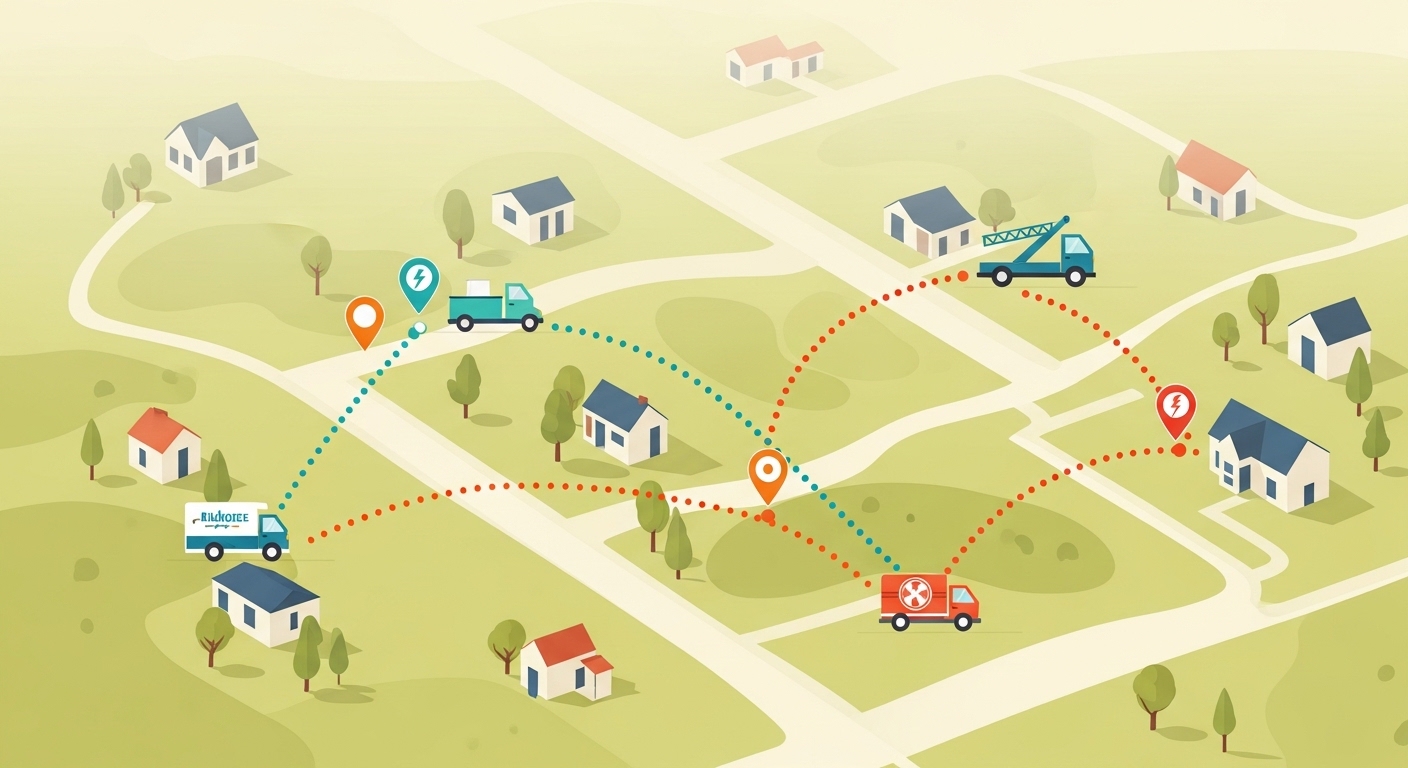
Once you have triaged and communicated, look at your remaining crews. The question is not "who was supposed to do this job?" The question is "who is closest to this job right now?"
If you have GPS visibility on your trucks (even just through phone sharing), you can identify the nearest available tech and reroute them to the highest-priority job from Step 1. This is where most contractors lose time: they try to rearrange the entire day's schedule on paper or in their head, when the fastest solution is to reassign two or three jobs based on geography and let the rest of the day adjust around those moves.
The goal is not a perfect day. The goal is to save the highest-value jobs and keep the most at-risk customers from walking. Everything else gets rescheduled.
Step 4: Follow Up Within 48 Hours With Priority Rescheduling
The breakdown day is over. You handled the crisis. Now comes the part most contractors skip entirely: structured follow-up.
Every customer who was rescheduled during the breakdown needs to hear from you within 48 hours, either confirming their new appointment or offering one. Customers who felt well-handled during the disruption are often more loyal afterward than customers who never experienced a problem at all. But only if you close the loop.
If a customer got bumped and you still have not contacted them two days later, they are not waiting for you. They already called someone else. This is where contractors lose thousands in April follow-up failures: not from the breakdown itself, but from the silence that follows it.
For high-value customers or anyone who seemed frustrated during the initial call, consider a small goodwill gesture. A $25 discount on the rescheduled visit, a free add-on service, or even just a personal call from the owner goes a long way. The cost is minimal. The retention value is significant.
Step 5: Request Reviews After Every Successfully Recovered Job
This is the step that turns a bad week into a reputation builder. After you complete a rescheduled job, ask the customer for a review. Not a generic "how did we do?" but a specific ask: "We know the scheduling change was inconvenient, and we appreciate your patience. If you were happy with how we handled it, a quick Google review would mean a lot to us."
Customers who experienced a problem that was handled well leave some of the most detailed, positive reviews a contractor can get. Those reviews specifically mention responsiveness, communication, and professionalism, which are exactly the signals new customers look for when choosing between contractors online. One recovered breakdown can generate three to five strong reviews if you ask.
3 Mistakes That Turn a One-Day Breakdown Into a One-Week Crisis
Even with a recovery playbook, these three mistakes can extend the damage far beyond the breakdown itself.
Going dark on inbound calls during the crisis. While you are managing the breakdown, new leads are still calling. If those calls go to voicemail during your busiest season, you are losing new revenue on top of the revenue you already lost to the breakdown. Research shows that 78% of customers buy from the first company to respond. If your phone is ringing and nobody picks up, that lead is gone in minutes. Even a simple auto-reply text ("Thanks for calling [company name]. We're on a job right now and will call you back within 30 minutes.") can hold a lead long enough for you to follow up. If you are still losing April leads to slow response times, this post breaks down what it is actually costing you.
Rescheduling informally and then forgetting. "I'll call them back later" is the most expensive sentence in contracting. If a rescheduled job does not go into your calendar, your CRM, or at a minimum, a written list within an hour of the disruption, it will fall through the cracks. The customer will not remind you. They will just leave a bad review or quietly hire someone else.
Skipping the post-crisis debrief. After the breakdown is resolved and the week is over, sit down for 20 minutes and answer three questions. What broke down and why? Which customers did we lose? What would we do differently next time? Write it down. Contractors who debrief after disruptions build institutional knowledge that makes the next crisis cheaper and faster to recover from. Contractors who do not debrief have the same $3,000 day every April.
Why April Breakdowns Hit Harder Than Any Other Month
April is uniquely punishing for equipment failures because of what is happening across every trade at once.
HVAC contractors are launching cooling season tune-ups as temperatures climb. A van breakdown during a week of 80-degree days means customers with no AC are calling your competitors before lunch. Plumbers are handling burst pipe callbacks and the spring inspection season. Electricians, roofers, and landscapers are all ramping into their busiest stretch of the year simultaneously, which means subcontractor availability (your backup plan) is at its lowest.
The BLS projects roughly 608,100 openings per year across installation, maintenance, and repair occupations. The labor market is tight, competition is growing, and customer expectations for fast service have never been higher. A breakdown with no recovery plan in April costs you more than the same breakdown in November, because every lost job in April had a replacement customer ready to fill it.
FAQ
Q: How do I communicate a schedule change to 10 or 15 customers in 30 minutes?
Write a single text template before the crisis happens. Something like: "Hi, this is [company]. We had an unexpected equipment issue today and need to reschedule your appointment. We have [date/time] available this week. Reply YES to confirm or call us at [number]." Send it to every affected customer at once. Personal calls go to the top two or three highest-risk relationships from your triage list.
Q: What should I offer an impacted customer to keep them from leaving a bad review?
Start with a phone call. Most customers do not want a discount. They want acknowledgment and a fast resolution. A personal call, a confirmed reschedule within 48 hours, and a brief apology for the inconvenience handles 90% of situations. For customers who were visibly frustrated or who you have rescheduled more than once, a $25 credit or a free add-on service is a small price to pay for retention.
Q: How do I calculate the actual revenue impact of a breakdown, not just the repair cost?
Add up the billable value of every job that was canceled, rescheduled, or shortened because of the disruption. Then add the estimated value of any inbound leads that went unanswered during the crisis window. Finally, factor in any review damage or customer churn that resulted. Fleet industry research puts the productivity loss alone at $448 to $760 per vehicle per day, before you count the repair bill or the lost leads.
Q: I run a two-person operation. Is a recovery playbook realistic for my size?
It is even more critical at your size. A solo operator or two-person crew has zero margin for error during a breakdown because there is nobody else to absorb the work. The five steps above take less than an hour total and require no software. Write your text template today, keep a triage checklist in your truck, and build the habit of 48-hour follow-up. The smaller your crew, the more every recovered job matters. If you are a small operation still tracking jobs on spreadsheets, a breakdown is where that system fails hardest.
Build the System Before the Next Breakdown Tests You
The playbook above works with a notebook, a phone, and discipline. But the contractors who recover fastest are the ones who built systems that automate the hardest parts: dispatching by GPS proximity, sending customer notifications automatically, tracking every rescheduled job so nothing falls through the cracks, and capturing reviews after every completed appointment.
That is what FieldServ AI does. It turns this five-step playbook into something that runs in minutes instead of hours, so your next April breakdown is a 30-minute inconvenience instead of a week-long crisis. Start your free 21-day trial and see how it maps to your operation before the next disruption hits.
Tags
Written by
FieldServ AI Team
Field service management insights from the FieldServAI team.
Related Articles

Myth Busted: Solo Contractors Need Field Service Management Software
Think you're too small for a CRM? Solo field service contractors are losing jobs, reviews, and revenue without one. Here's the real math.

Myth Busted: Does Field Service Management Software Really Save Time?
Does field service management software really save contractors time? We bust the myth with 2026 data and real-world insights every contractor needs.

April Cash Flow Crisis: Field Service Management Software Fixes Payment Collection
April cash flow crisis crushing your business? Slow payments cost construction $280B in 2024. Discover how field service management software fixes payment collection in 48 hours with automated invoicing, instant payment links, and smart follow-ups.
See FieldServ AI in Action
Get a personalized demo and see how AI-powered field service management can transform your business.
Book Your Demo