
Field Service Management Software vs. Dispatch-Only Tools: Which Saves More in 2026
Dispatch tools solve one problem. Full field service management software fixes them all. See which actually saves contractors more money in 2026.

The Tool You're Using Might Be Costing You More Than You Think
You invested in a dispatch tool because you needed to stop the scheduling chaos. But now you're wondering why your field service management software costs are still climbing, your techs are still double-booking, and your evenings are still buried in paperwork. Sound familiar?
Here's the uncomfortable truth: dispatch-only tools solve one problem while leaving a dozen others wide open. In 2026, contractors who are truly pulling ahead aren't just dispatching smarter. They're running their entire operation from a single connected platform, and the financial difference is staggering.
This post breaks down exactly what you get with each approach, what each one actually costs you (including the hidden stuff), and which one is worth your money when you're trying to grow a real business.
What Dispatch-Only Tools Actually Do (And Don't Do)
A dispatch-only tool does one thing reasonably well: it helps you get a technician from point A to point B. You can assign jobs, view a calendar, maybe track a truck on a map. For a solo operator running three jobs a day, that might feel like enough.
But here's where it breaks down fast. Dispatch tools don't capture customer history. They don't follow up on unpaid invoices. They don't automatically request reviews after a job is complete, recover missed calls with instant text responses, or flag that your top client hasn't booked in six months. Every one of those gaps is revenue walking out the door.
According to Upper Inc, typical dispatch software ROI ranges from 300% to 1,500% depending on fleet size and current inefficiency levels. That sounds impressive until you realize a 20% improvement in any single category translates to tens of thousands in annual savings. Dispatch-only tools improve one category. A full platform improves all of them simultaneously.
The other problem is stitching. When your dispatch tool doesn't talk to your invoicing software, which doesn't talk to your CRM, which doesn't talk to your review platform, someone on your team (probably you) is manually bridging those gaps every single day. That labor cost is invisible but very real.
What Full Field Service Management Software Actually Covers
A true field service management platform isn't just dispatch with more buttons. It's an operating system for your entire business. Think about everything that has to happen between the moment a customer calls and the moment money hits your account. Every single step in that lifecycle should be automated, tracked, or simplified.
Here's what a complete platform handles that a dispatch tool never touches:
- Smart scheduling with double-booking prevention so your techs never show up at two places at once
- A mobile CRM with full customer history so your team knows exactly who they're walking in to see
- Professional quotes and proposals sent digitally with e-signature capture, right from the field
- Integrated payments and automated collections so you stop chasing invoices at midnight
- Automated 5-star review requests sent at exactly the right moment after job completion
- Missed call recovery using instant text-back responses so you never lose a lead to voicemail again
- Inventory management with auto purchase order generation so your techs always have what they need
- Business analytics and profit reporting so you actually know which jobs make money and which ones don't
- Workflow automation and intelligent follow-ups that nurture customers into repeat and recurring business
- GPS real-time dispatch and job tracking with geofencing and verified time tracking
That's not a feature list. That's the difference between running a business and being run by one. You can explore the full picture at FieldServAi to see how these tools connect into one seamless workflow.
The Real Numbers: What the Research Shows
Let's talk dollars, because that's what actually matters when you're deciding where to spend your money.
According to IFS, teams report 40% lower admin time, doubled productivity, and 10 to 20% lower operating costs when modernizing their field service operations, particularly in high-volume, distributed environments. If you're running even five crews, a 15% cut in operating costs is not a small number.
Research from Programming Insider reports that companies implementing full FSM tools typically achieve a 15 to 30% reduction in fuel and travel costs through optimized routing alone. That same research cites MarketsandMarkets data showing the global FSM market is projected to grow from $5.10 billion in 2025 to $9.17 billion by 2030, driven by exactly the kind of ROI contractors are experiencing on the ground.
This isn't just software vendor marketing. McKinsey's analysis of more than 50 industrial organizations over 15 years found that companies with a high service focus generated 1.7 times the total shareholder returns of those focused mainly on products. The contractors investing in service infrastructure, including software, are the ones compounding their value over time.
For more context on how these numbers play out at the contractor level, the team at FieldServ AI put together a helpful breakdown in Myth Busted: Does Field Service Management Software Really Save Time? that's worth reading before you make any decisions.
Where Dispatch-Only Tools Win (And Where They Fall Short)
To be fair, dispatch-only tools aren't useless. For a brand-new solo operator who just needs to organize a handful of jobs, they can be a practical starting point. They're usually cheaper upfront, faster to learn, and lighter on features you don't need yet.
But "cheaper upfront" is a trap. If you're losing two leads a week to missed calls and your text-back isn't automated, that's easily $1,000 to $3,000 in lost revenue monthly depending on your ticket size. If you're not following up after estimates, your close rate is hemorrhaging. If you're manually entering data across three platforms, you're paying someone real hours to do it.
If you're a solo contractor wondering whether you've outgrown your current tools, check out Myth Busted: Solo Contractors Need Field Service Management Software for a clear-eyed look at when the upgrade pays for itself.
The short version: dispatch tools make sense for a very narrow window of early-stage operation. Once you're handling recurring customers, multiple techs, or any kind of sales pipeline, you've outgrown the tool. The question isn't whether you'll need more. It's whether you'll upgrade before or after the bottleneck costs you real money.
HVAC, Plumbing, and Electrical Contractors: The Stakes Are Even Higher
If you're running an HVAC business, plumbing company, or electrical contracting operation, the cost of a missed follow-up or botched dispatch is higher than almost any other trade. Emergency service calls are high-ticket. Repeat maintenance customers are the backbone of stable revenue. Reputation is everything in a local market.
A solid hvac business software stack needs to handle seasonal demand spikes, recurring maintenance agreements, and fast quote turnaround. A plumbing business software solution has to manage emergency dispatch, collect payment on-site, and capture reviews before the truck leaves the driveway. A robust field service CRM and contractor CRM software keeps all of that customer data organized and actionable, not buried in a spreadsheet.
These aren't nice-to-haves. When your competitor down the street is using a full platform and you're still dispatching from a whiteboard, you are losing jobs you don't even know you lost. A complete field service app closes that gap fast. Explore industry-specific solutions at FieldServAi to see how FieldServ AI is built for the specific challenges contractors face every day.
If cash flow is a pressure point for your operation, you'll also want to read April Cash Flow Crisis: Field Service Management Software Fixes Payment Collection for a practical breakdown of how integrated payments change the math.
Which One Actually Saves Money in 2026?
The math isn't complicated. Dispatch-only tools solve one problem at a fraction of the total cost you're losing across your whole operation. Full field service management software eliminates the inefficiencies that are draining your business at every stage of the job lifecycle.
If you're serious about growing, streamlining your team, and actually knowing your numbers at the end of every month, there's only one answer. And the good news is you don't have to stitch together five different apps and hope they talk to each other. Platforms like FieldServ AI bring everything under one roof, from scheduling and dispatch to payments, reviews, inventory, analytics, and automation.
Ready to see what a complete system looks like for your specific operation? Contact Us | FieldServ AI - Field Service Management Software and let's find out exactly what you're leaving on the table.
Frequently Asked Questions
Q: Can a small or solo contractor afford full field service management software?
Yes, and in most cases they can't afford not to have it. Solo operators lose the most to missed calls, unbilled work, and manual admin tasks because every hour of lost efficiency falls directly on one person. The right platform pays for itself quickly through recovered leads and automated collections alone.
Q: How is field service management software different from a dispatch app?
A dispatch app handles scheduling and routing. A full field service management platform covers the entire job lifecycle: lead capture, quoting, scheduling, dispatch, GPS tracking, payments, customer follow-up, reviews, reporting, and more. The difference in ROI is significant because you're improving every revenue touchpoint, not just one.
Q: What's the ROI timeline for switching to a full FSM platform?
Most contractors see measurable ROI within the first 30 to 90 days, particularly from automated payment collection and missed call recovery. Full operational gains, including better scheduling efficiency and repeat customer rates, typically compound over the first six to twelve months.
Q: Do I need to replace all my existing tools at once?
Not necessarily. The best approach is to start with the features that address your biggest pain points first, then expand. A platform like FieldServ AI is built to grow with your business, so you can start where you are and add capabilities as your operation scales.
Q: Is there a learning curve when switching from dispatch-only tools to a full platform?
There is an adjustment period, but modern platforms like FieldServ AI are built specifically for field operators, not software engineers. Most contractors and their teams are up and running in days, not weeks. The automation does the heavy lifting once it's set up, which means your team spends less time on admin almost immediately.
Tags
Written by
FieldServ AI Team
Field service management insights from the FieldServAI team.
Related Articles
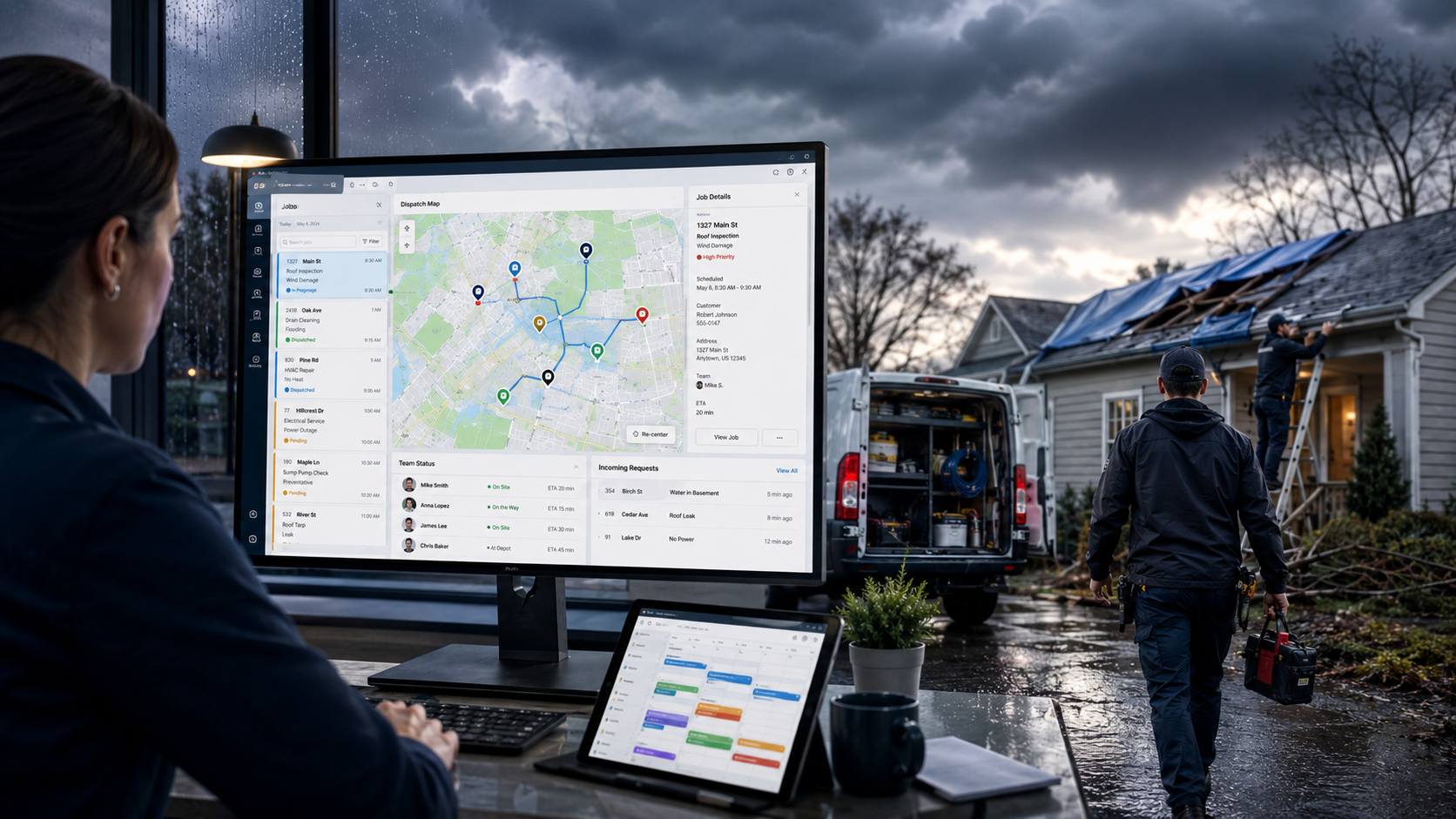
May Weather Emergencies: 7 Field Service Management Software Features That Prevent $10K+ in Missed Spring Storm Jobs
Spring storms create massive demand spikes. Discover 7 field service management software features that help contractors capture $10K+ in missed storm jobs.
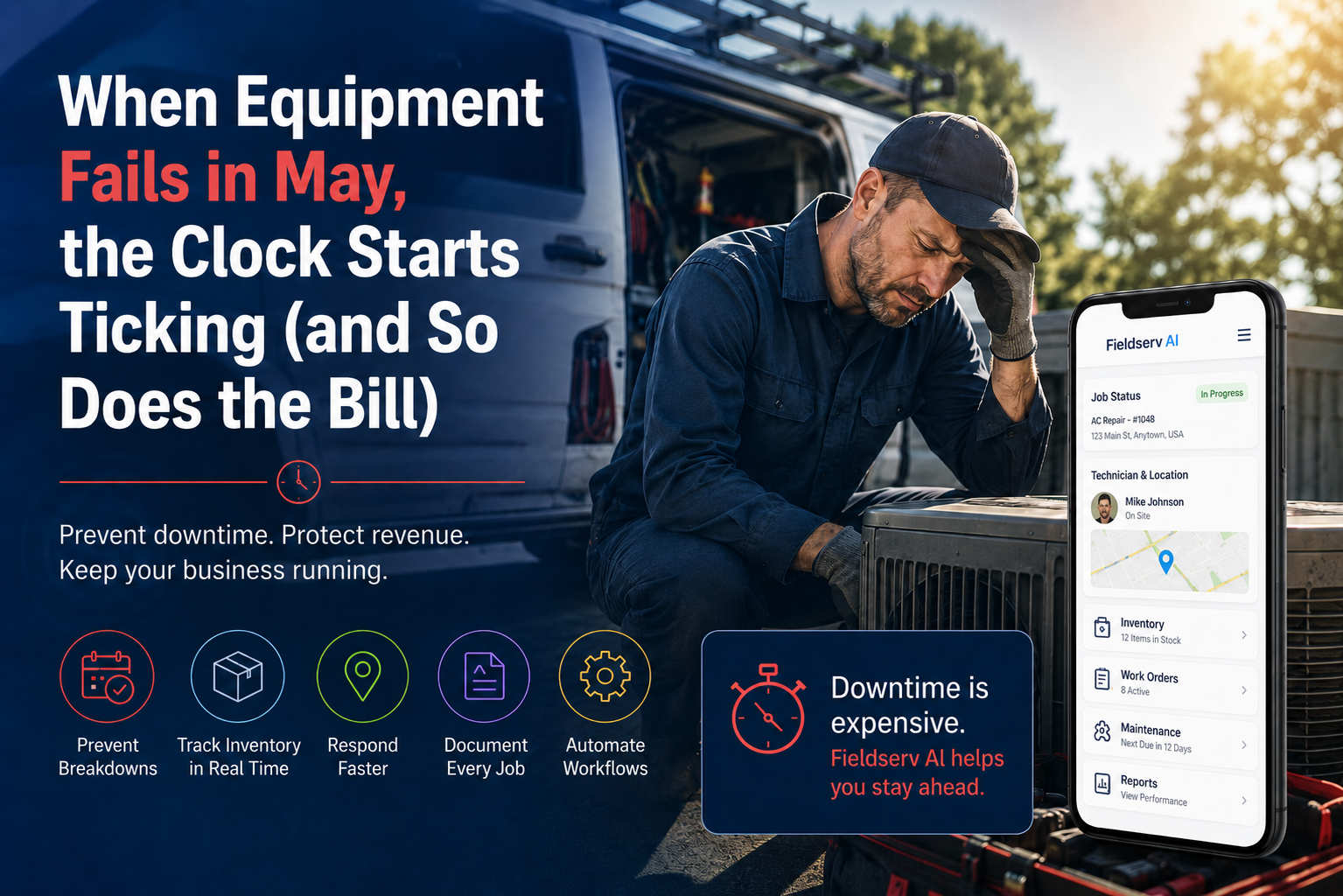
May Equipment Failures: Field Service Management Software Stops $10K+ Downtime
Equipment failures in May cost field service businesses thousands. Here are 5 ways field service management software stops the damage before it starts.

May Invoice Delays: Field Service Management Software Fixes Slow Pay
May invoice delays are draining contractor cash flow. Learn why 82% of contractors wait 30+ days to get paid and how field service management software fixes it fast.
See FieldServ AI in Action
Get a personalized demo and see how AI-powered field service management can transform your business.
Book Your Demo