
500+ Reviews! How This Milestone Drives Real Revenue for Field Service Businesses
What separates field service businesses that dominate their local markets from those constantly scrambling for the next job? Often, it comes down to a number most contractors overlook: their review count. Businesses with strong review profiles earn 32% more revenue than competitors with weaker onlin
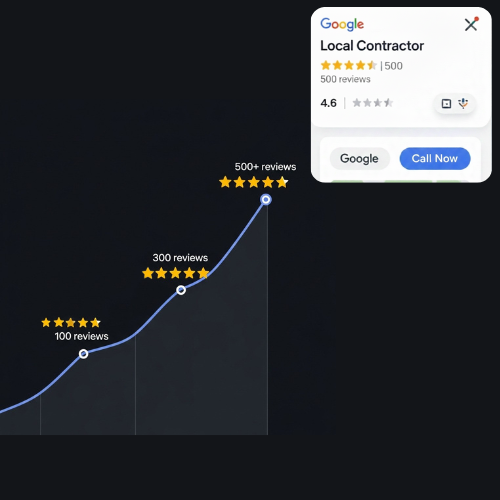
What separates field service businesses that dominate their local markets from those constantly scrambling for the next job? Often, it comes down to a number most contractors overlook: their review count.
Businesses with strong review profiles earn 32% more revenue than competitors with weaker online reputations. That’s not marketing theory. That’s measurable money showing up in bank accounts because customers trust what other customers say.
The challenge is that most field service businesses collect reviews accidentally. A happy customer might remember to leave one. A technician might awkwardly ask at the end of a job. Maybe a follow-up email goes out when someone remembers to send it. This approach produces scattered results, typically leaving businesses stuck with 20, 40, maybe 60 reviews after years of operation.
Meanwhile, contractors who systematically automate review requests are building review counts that fundamentally change their competitive position. They hit 100 reviews in their first year. They have crossed 300 reviews while competitors are still figuring out how to ask. They reach 500+ reviews and watch their phone ring with customers who never even considered calling anyone else.
The path from inconsistent review collection to a 500+ review reputation isn’t about working harder. It’s about building systems that turn every completed job into a review opportunity without adding work to your team’s day. When review requests happen automatically after job completion, when photos from the work site get attached without manual effort, and when the timing and messaging are optimized without anyone thinking about it, review growth becomes inevitable rather than accidental.
This is where automation transforms the economics of customer acquisition for field service businesses.
Why Does Your Review Count Impact Revenue More Than Most Marketing Investments?
Most field service business owners think of reviews as a “nice to have” rather than a core revenue driver. The data suggests they’re dramatically underestimating what reviews are worth.
How Does a Higher Star Rating Translate to Actual Revenue Growth?
Businesses with 4+ star ratings earn 32% more revenue than those with lower ratings. This isn’t correlation. It’s causation. When 91% of homeowners check online reviews before choosing a contractor, your star rating becomes the first filter that determines whether you even get considered.
The math compounds at every stage of the customer journey. Consumers read an average of 10 reviews before feeling confident enough to contact a local business. If you only have 15 reviews total, potential customers are reading almost your entire review history and wondering why you don’t have more. If you have 150 reviews, they’re sampling a small percentage and seeing consistent quality across dozens of experiences.
Here’s where review count creates separation: for every 10 new reviews a business earns, conversion rates on its Google Business Profile improve by 2.8%. That means a business with 100 reviews converts visitors to calls at a measurably higher rate than a business with 50 reviews. A business with 500 reviews has compounded that advantage fifty times over.
When you respond to those reviews, the effect multiplies further. Businesses that respond to 25% or more of their reviews see an additional 4.1% conversion improvement. Reviews aren’t just social proof. They’re active conversion optimization.
Why Do Reviews Outperform Paid Advertising for Customer Acquisition?
Field service businesses routinely spend $40-100+ per lead on Google Ads. A plumber in a competitive market might pay $80 per click, needing five clicks to generate one qualified lead. That’s $400 per lead before any conversion happens.
Reviews generate leads at a fraction of that cost, often approaching zero marginal cost per lead once systems are in place. When a potential customer searches “HVAC repair near me” and sees your business with 487 reviews versus a competitor with 52 reviews, you’re winning that consideration without paying for the click.
The compound effect matters here. Paid advertising stops working the moment you stop paying. Every dollar you spent on ads last month has zero impact on your lead flow today. Reviews, by contrast, accumulate. The review you earned six months ago is still working for you today, still building trust, still converting browsers into callers.
Consider the lifetime value calculation. A field service business spending $2,000 monthly on ads might generate 25-50 leads. That same business investing in automated review systems might spend $200-400 monthly on software while generating review velocity that improves organic conversion rates permanently. Within a year, the review-focused business has built an asset. The ad-dependent business has expenses.
Businesses with 9+ recent reviews (posted within the last 90 days) earn 52% more than average. This recency factor explains why automation matters so much. Manual review collection produces bursts of activity followed by gaps. Automated systems produce a consistent weekly review flow that signals to both search algorithms and potential customers that your business is actively serving satisfied clients.
What Makes 100 Reviews the First Milestone That Changes Everything?
The journey to 500+ reviews doesn’t start at 500. It starts with your first hundred, and that milestone alone transforms how customers perceive your business.
Why Do Customers Trust Businesses Differently After 100 Reviews?
Consumers need an average of 40 reviews before they believe a business’s star rating is accurate. Below that threshold, potential customers view your rating with skepticism. Maybe you just got lucky with a few happy customers. Maybe those reviews are from friends and family. Maybe the sample size is too small to trust.
At 100 reviews, you’ve crossed into credibility territory. You’ve demonstrated that dozens of real customers had experiences worth documenting. Your 4.7-star rating isn’t a fluke. It’s a pattern.
The trust difference shows up in behavior. 74% of consumers say they would contact a business that displays customer reviews, compared to only 62% who would contact a business without visible reviews. That 12-percentage-point gap represents real leads that never call competitors who haven’t built their review presence.
For field service businesses specifically, 100 reviews typically places you in the top 10-20% of local competitors. Most contractors in any given market have fewer than 50 reviews. Reaching 100 creates immediate differentiation that customers notice when comparing options.
How Long Should It Take to Reach 100 Reviews with Automation?
Without automation, reaching 100 reviews might take 3-5 years of inconsistent effort. With proper automated systems, most field service businesses can hit 100 reviews within 6-12 months.
The math depends on two factors: job volume and request-to-review conversion rate.
Only 1-3% of happy customers leave reviews without being asked. If you complete 50 jobs per month and never ask for reviews, you might get 1 review monthly. At that rate, 100 reviews takes over 8 years.
Automated review requests boost response rates by up to 80%. When every completed job triggers a personalized review request sent at the optimal time, conversion rates climb to 10-20% or higher. Now those same 50 monthly jobs produce 5-10 reviews. You hit 100 reviews in 10-20 months.
The businesses reaching 500+ reviews aren’t doing anything magical. They’re simply capturing the review potential that already exists in their completed work. Every job represents a satisfied customer who would leave a positive review if asked properly and at the right moment. Automation ensures that asking happens consistently, not occasionally.
Platforms like FieldServ Ai build review automation directly into the job completion workflow. When a technician marks a job complete, the system automatically triggers a review request to the customer. No one has to remember. No one has to send a manual email. The process happens in the background while your team focuses on the next job.
How Do Job Site Photos Multiply the Impact of Every Review?
Reviews with text are valuable. Reviews with photos are significantly more powerful.
Why Are Customers 62% More Likely to Engage with Visual Reviews?
62% of consumers are more likely to purchase when they see photos and videos from other customers. For field service businesses, this statistic has direct implications for how reviews should be structured.
When a potential customer reads “Great job on my AC repair, highly recommend!” that review builds some trust. When they see that same review accompanied by photos of the actual work, the clean installation, the before-and-after comparison, the trust multiplies. Visual proof removes doubt in ways that text alone cannot accomplish.
Customers are 26% more likely to take action when reviews include user-generated images. That’s not a minor improvement. That’s more than one in four additional conversions driven purely by the presence of photos.
For field service businesses, job site photos serve multiple purposes. They document work for warranty and liability purposes. They create marketing assets for social media and websites. And when attached to review requests, they give customers visual prompts that make leaving detailed reviews easier.
Think about the customer experience. They receive a review request that says, “Thanks for choosing us for your plumbing repair. Here are photos from the completed work. Would you take a moment to share your experience?” Now they’re looking at professional photos of the work done in their home. They’re reminded of the quality. They have visual context for writing their review. The barrier to leaving feedback drops significantly.
How Does Automated Photo Attachment Change Review Quality?
Manual photo collection creates friction. Technicians take photos but forget to upload them. Photos sit on phones instead of getting attached to customer records. When review request time comes, no one knows which photos go with which job.
Automated systems eliminate this friction by tagging photos to specific jobs and automatically including them in review requests. FieldServ Ai allows technicians to capture job site photos that get automatically attached to customer records. When the review request goes out after job completion, relevant photos can be included without any additional work.
This automation produces three benefits. First, review requests become more engaging because they include visual proof of completed work. Second, customers write more detailed reviews because they have visual context to reference. Third, the reviews themselves become more valuable to future customers who see both the written feedback and the photographic evidence.
Businesses that combine automated review requests with automated photo attachment build review profiles that competitors simply cannot match through manual effort.
What Does the Path from 100 to 500+ Reviews Actually Look Like?
Reaching 100 reviews proves your system works. Scaling to 500+ reviews requires maintaining that system while your business grows.
What Review Velocity Should Field Service Businesses Target?
Review velocity refers to how many new reviews you generate per month. Consistent velocity matters more than occasional bursts because recency signals to both customers and search algorithms that your business is actively serving clients.
For a field service business completing 100 jobs monthly with a 15% review conversion rate, the math produces 15 new reviews per month. At that velocity, you add 180 reviews annually. A business starting at 100 reviews crosses 500 reviews in roughly 2.5 years of consistent operation.
The compounding effect accelerates growth over time. More reviews improve your search visibility, which generates more leads, which produces more jobs, which creates more review opportunities. Businesses at 500+ reviews often find their review velocity increasing rather than plateauing because their market position generates more customer volume.
Businesses with 9+ recent reviews earn 52% more than average. This recency premium means that a business adding 15 reviews monthly isn’t just building a cumulative count. They’re continuously refreshing their recency signals, maintaining premium positioning in search results and customer consideration.
How Do Automated Systems Scale Review Collection Without Adding Work?
The beauty of automation is that scaling doesn’t require proportional effort increases. Whether you complete 50 jobs monthly or 500 jobs monthly, the automated review request system operates identically. More jobs simply means more review requests sent automatically, more reviews collected, and faster velocity toward your milestones.
Manual review collection scales poorly. Asking technicians to remember review requests when they’re focused on completing quality work creates inconsistent results. Asking office staff to send individual follow-up emails for every completed job creates an administrative burden that compounds as you grow. The businesses stuck at 50-100 reviews often aren’t failing because their customers are unhappy. They’re failing because their manual processes can’t keep pace with their job volume.
Automation inverts this relationship. Higher job volume becomes an advantage because each additional job represents another automated review opportunity. The systems handle the work. Your team handles the service. Reviews accumulate as a natural byproduct of doing good work consistently.
FieldServ Ai integrates review automation into the same platform that manages scheduling, dispatch, and customer communication. This integration means review requests don’t require separate software, separate logins, or separate workflows. They happen as part of the job completion process that’s already built into daily operations.
The Bottom Line
The field service businesses building 500+ review profiles aren’t working harder than their competitors. They’re working smarter by automating the review collection process that most contractors handle manually or not at all.
When 91% of customers check reviews before choosing a contractor and businesses with strong review profiles earn 32% more revenue, reviews stop being a marketing afterthought and become a core business system. The path from your current review count to 100 reviews, then to 500+, comes down to one decision: will you capture the review potential that already exists in your completed work, or will you let it evaporate job after job?
Automation makes the capture automatic. Every completed job becomes a review opportunity. Every satisfied customer receives a perfectly timed request. Every review builds toward milestones that fundamentally change how customers find and choose your business.
Frequently Asked Questions
How many reviews does a field service business need to be competitive locally? Most local markets have contractors clustered in the 20-60 review range. Reaching 100 reviews typically places you in the top 10-20% of competitors. At 500+ reviews, you’re often the clear market leader in review count, which significantly impacts how customers perceive your credibility compared to alternatives.
Why do customers trust businesses with more reviews? Consumers need an average of 40 reviews before they believe a star rating is accurate. Below that threshold, ratings seem potentially unreliable or based on too small a sample. Higher review counts signal that dozens or hundreds of real customers had experiences consistent with the displayed rating.
How much more revenue do businesses with good reviews actually earn? Research shows businesses with 4+ star ratings earn 32% more revenue than lower-rated competitors. Additionally, every 10 new reviews improves Google Business Profile conversion rates by 2.8%, and businesses responding to 25%+ of reviews see an additional 4.1% conversion improvement.
What percentage of happy customers leave reviews without being asked? Only 1-3% of satisfied customers leave reviews without prompting. This explains why businesses relying on organic review collection stay stuck at low review counts despite years of operation. Automated review requests boost response rates by up to 80%, dramatically changing collection velocity.
How long does it take to reach 100 reviews with automated systems? Most field service businesses can reach 100 reviews within 6-12 months using automated review requests. The timeline depends on job volume and request-to-review conversion rates, which typically range from 10-20% with properly optimized automated systems.
Do reviews really outperform paid advertising for ROI? For most field service businesses, yes. Paid advertising stops generating leads the moment you stop paying. Reviews accumulate as a permanent asset, continuing to build trust and convert customers indefinitely. Businesses with 9+ recent reviews earn 52% more than average, representing ongoing returns from past review collection efforts.
Why do job site photos matter for review requests? Customers are 62% more likely to engage with reviews that include photos and videos. When review requests include photos from the completed job, customers have visual context that makes writing reviews easier and more detailed. Photos also increase the persuasive power of reviews for future customers.
How do automated review requests work in practice? When a technician marks a job complete in your field service management software, the system automatically sends a personalized review request to the customer. The timing, messaging, and platform targeting are handled by the system without requiring manual effort from your team.
What review platforms should field service businesses prioritize? Google reviews matter most for local search visibility and customer discovery. Depending on your trade, platforms like Yelp, Facebook, Angi, and industry-specific sites may also influence customer decisions. Automated systems can direct customers to the most impactful platform based on your business priorities.
How do you maintain review velocity as your business grows? Automated systems scale with your business naturally. Whether you complete 50 or 500 jobs monthly, the automation sends review requests identically. More jobs mean more opportunities captured automatically, often accelerating review velocity as business volume increases.
Written by
FieldServ AI Team
Field service management insights from the FieldServAI team.
Related Articles

Field Service Management Software: 6 Fixes for June Revenue Leaks
June is your busiest and leakiest month. Here are 6 field service management software features that stop revenue leaks and keep multi-crew operations profitable.

The August Margin Leak: Why Peak Season Kills Profit
Contractors lose margin in busy months, not slow ones. Here are four peak-season leaks that never reach your revenue report, the math behind them, and why weekly margin review beats a monthly close.

Field Service Management Software: Set It Up in 48 Hours, No IT
Think field service management software needs IT skills? Myth busted. Here's the exact 48-hour, no-code setup plan solo contractors use to go live.
See FieldServ AI in Action
Get a personalized demo and see how AI-powered field service management can transform your business.
Book Your Demo